

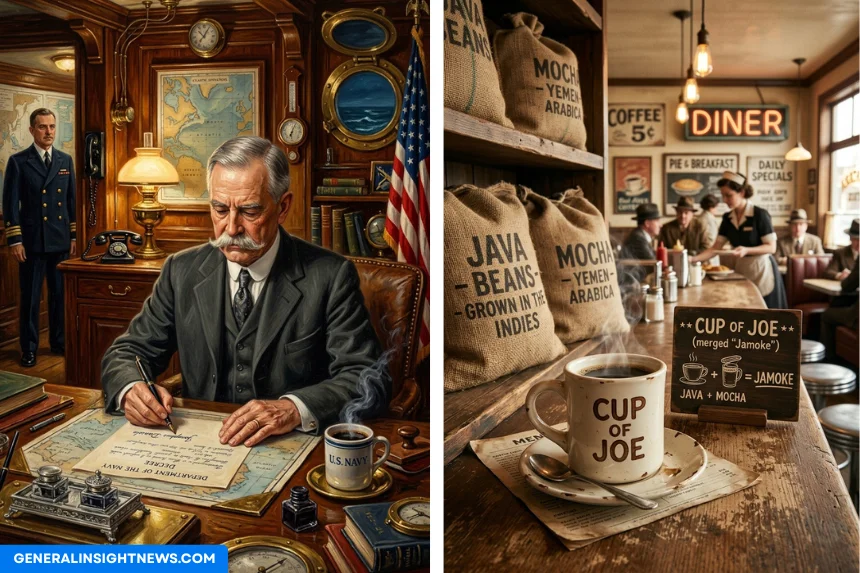
If you have ever wondered why is coffee called joe, historians and language researchers do not have one proven answer. However, the evidence shows that Americans connected the word “joe” with coffee by 1911, several years before the famous 1914 U.S. Navy alcohol order that often appears in origin stories.
The strongest theories connect “joe” with earlier coffee terms such as java, jamocha, and jamoke. Another possible influence comes from wordplay involving “Old Black Joe.” Therefore, the most accurate explanation does not point to one person named Joe. Instead, the nickname likely developed through American slang over time.
Quick Answer: Why Is Coffee Called Joe?
| Question | Quick answer |
|---|---|
| Why is coffee called joe? | No one has proved the exact origin. However, older coffee slang such as java, jamocha, and jamoke may have influenced joe. |
| What does “cup of joe” mean? | It means a cup of coffee, especially in informal American English. |
| Was Joe a real person? | No reliable evidence links the nickname to one confirmed person. |
| Did Josephus Daniels invent the term? | No. Evidence connects “joe” with coffee before Daniels issued his 1914 Navy alcohol order. |
| When did “joe” start meaning coffee? | Merriam-Webster traces the coffee meaning to 1911. |
| When did “cup of Joe” appear? | Researchers have identified a 1928 newspaper example. |
| Do Americans still say “cup of joe”? | Yes. Major dictionaries still list joe as informal American English for coffee. |
The Merriam-Webster definition of “joe” includes coffee as a recognized meaning. Similarly, the Cambridge English Dictionary entry for “joe” labels the term informal U.S. English.
Therefore, “cup of joe” remains part of modern American vocabulary even though its exact origin remains uncertain.
Key Facts About “Cup of Joe”
| Fact | What the evidence shows |
| Meaning | Informal term for coffee |
| Language | Primarily American English |
| Exact origin | Uncertain |
| “Joe” linked with coffee | Evidence reaches back to 1911 |
| “Cup of Joe” evidence | Researchers have found a 1928 example |
| Josephus Daniels order | Daniels signed it on June 1, 1914 |
| Strong linguistic theory | Java, jamocha, and jamoke may have influenced joe |
| “Average Joe” theory | Plausible, but unproven |
| Martinson Coffee theory | Interesting brand story, but unsupported as the original source |
| Modern use | Major dictionaries still recognize the coffee meaning |
Where Did the Word “Joe” for Coffee Come From?
No historical source gives us a definitive moment when someone first called coffee “joe.” Nevertheless, language evidence offers several clues.
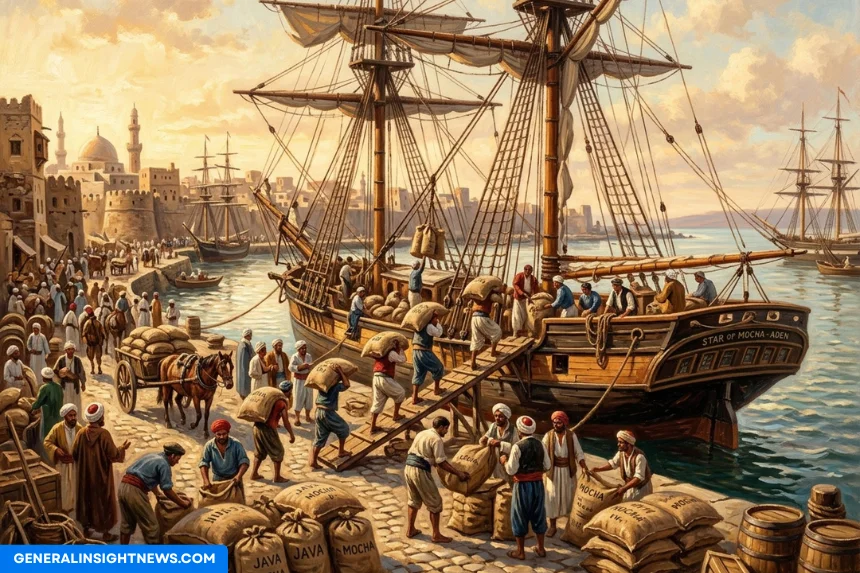
Researchers have traced a group of older coffee nicknames that appeared before or alongside “joe.” These include java, jamocha, and jamoke. Because those words already referred to coffee, many etymologists consider them more useful clues than later stories about individual people.
Java Became a General Word for Coffee
Java originally referred to the Indonesian island of Java. Dutch colonial producers turned the island into an important coffee-growing region, so consumers began associating the word “Java” with coffee.
Over time, English speakers started using “java” as a general word for coffee, even when the beans came from somewhere else. The Etymonline history of “java” traces that broader coffee meaning to the 19th century.
Therefore, Americans already had a habit of shortening or adapting geographic coffee names into everyday slang.
Mocha Helped Create More Coffee Slang
Mocha followed a similar path. The term comes from the historic Yemeni port of al-Makha, which played an important role in the coffee trade.
As a result, Java and Mocha became two widely recognized coffee names. Speakers then blended those names into forms such as jamoca, jamocha, and later jamoke.
The Wordorigins history of java and joe identifies American examples of these blended terms around the end of the 19th century.
Did “Joe” Come From Java and Jamoke?
This theory has more historical support than many popular alternatives.
Early slang sources connect joe directly with words such as jamoke and java. In 1930, a slang dictionary defined joe as coffee and suggested that speakers may have shortened it from jamoke.
Moreover, an early-1930s Reserve Officer’s Manual grouped “Jamoke, Java, Joe” together as coffee terms. That grouping matters because it shows that speakers treated the three words as related coffee slang.
How the Words May Have Changed
The possible development looks like this:
Java + Mocha → jamocha/jamoke → joe
No surviving source proves every step in that chain. However, this explanation fits the language people actually used.
In addition, it does not require us to assume that one person suddenly created the nickname. Instead, it reflects the way slang often changes: speakers shorten words, blend familiar terms, and adopt easier forms.
Therefore, the java-jamoke-joe theory remains one of the strongest explanations available.
How Early Did People Call Coffee Joe?
Many articles once placed the coffee meaning of joe in the 1930s. However, earlier evidence now pushes the timeline back.
The important point is that researchers must separate “joe” meaning coffee from the full phrase “cup of Joe.” Those forms appear at different points in the historical record.
1911: “Joe” Already Had a Coffee Connection
Merriam-Webster currently gives 1911 as the first known use of joe in the coffee sense.
Historical-language research also points to a February 27, 1911, “Osgar und Adolf” cartoon. The cartoon used song titles as restaurant order jokes, and “Old Black Joe” referred to black coffee.
That example does not prove that the song created the slang. However, it shows that a coffee-related association with “Joe” already existed in 1911.
1928: Researchers Find “Cup of Joe”
The complete phrase appears later.
Lexicographer Ben Zimmer identified a “cup of Joe” example in an October 31, 1928, California newspaper item that included verse connected with a U.S. Marine serving in Nicaragua.
Therefore, the phrase had entered military-related usage by the late 1920s.
This evidence also challenges articles that call a 1930s source the first appearance of “cup of Joe.” Researchers may uncover even earlier examples in the future, but the 1928 evidence already moves the known timeline backward.
Timeline of “Joe” as Coffee Slang
| Date | Development |
| 1700s | Java grows in importance as an international coffee-producing region. |
| 1800s | Americans begin using “java” as a general word for coffee. |
| 1899 | U.S. sources show jamoca/jamoka connected with coffee. |
| 1911 | A cartoon links “Old Black Joe” with black coffee, and dictionaries trace coffee-related joe to this period. |
| 1914 | Josephus Daniels signs General Order No. 99 restricting alcoholic drinks in the Navy. |
| 1928 | A newspaper item connected with a Marine uses “cup of Joe.” |
| 1930 | A slang dictionary defines joe as coffee and links it with jamoke. |
| Early 1930s | A Reserve Officer’s Manual groups Jamoke, Java, and Joe as coffee slang. |
| Today | Major dictionaries still list joe as an informal American word for coffee. |
Did Josephus Daniels Make Coffee a “Cup of Joe”?
Probably not.
Josephus Daniels served as U.S. Secretary of the Navy under President Woodrow Wilson. On June 1, 1914, Daniels signed General Order No. 99, which restricted alcoholic drinks aboard Navy vessels and at Navy facilities.
The Naval History and Heritage Command copy of General Order No. 99 shows that the rule took effect on July 1, 1914.
Why the Navy Story Became Popular
According to the legend, sailors blamed Daniels for removing alcohol. Coffee then became one of the strongest everyday drinks available, so sailors supposedly mocked Daniels by calling coffee a “cup of Joe.”
The story sounds memorable. Moreover, it gives the phrase a simple origin and a recognizable historical figure.
However, a good story does not automatically make good etymology.
Why the Dates Do Not Support the Daniels Theory
The timeline causes the biggest problem.
Evidence already connects “joe” with coffee in 1911. Daniels did not sign his order until 1914. Therefore, his Navy policy could not have created the original coffee meaning.
The U.S. Naval Institute discussion of the “cup o’ joe” story also provides useful historical context.
In addition, the Navy had already ended the traditional spirit ration in 1862. Daniels’ order further restricted alcohol, including officers’ wine messes, but he did not suddenly remove a daily liquor ration from every ordinary sailor in 1914.
Consequently, historians should treat the Daniels explanation as folklore rather than the strongest origin theory.
Could “Cup of Joe” Mean the Average Man’s Drink?
Possibly, but no source proves it.
English speakers have long used “Joe” as a generic name for an ordinary man. Merriam-Webster traces that meaning back to the 19th century.
Later expressions such as “Joe Blow” and “average Joe” strengthened the connection between Joe and an everyday person.
Why the Theory Sounds Reasonable
Coffee became an inexpensive, familiar drink for workers, soldiers, diners, travelers, and families. Therefore, calling it the drink of the “average Joe” sounds natural.
However, the available historical evidence does not show people consciously naming coffee after the ordinary man.
Instead, this association may have helped the nickname survive after people started using it for other reasons.
So, the average-Joe theory remains plausible, but it does not provide a proven origin.
Did Joe Martinson Inspire “Cup of Joe”?
Another popular theory points to Joe Martinson, the founder associated with Martinson Coffee.
The company traces its New York roots to 1898. Later marketing connected the brand strongly with its founder’s first name and the phrase “cup of Joe.”
Therefore, some writers have suggested that customers originally asked for “Joe’s coffee” and eventually shortened the expression.
What the Evidence Actually Shows
The theory faces one major problem: researchers have not found early independent evidence that Martinson Coffee created the phrase.
The Etymonline entry for “joe” notes that the dates make the connection possible. However, it also explains that the claim lacks historical support and appears much later in company advertising.
Consequently, the Martinson story works better as brand folklore than as established etymology.
The 1911 coffee-related use of “Joe” also makes the marketing story less convincing as the sole origin.
Did “Old Black Joe” Inspire the Nickname?
“Old Black Joe” offers another interesting clue.
American songwriter Stephen Foster wrote “Old Black Joe” in 1860. More than 50 years later, a 1911 cartoon used the title as a joke for black coffee.
That connection matters because it shows that readers could understand “Joe” in a coffee context at that time.
A Clue Is Not the Same as Proof
However, the song itself has nothing to do with coffee.
Therefore, researchers cannot tell whether the song title helped create the coffee nickname or whether the cartoonist simply used existing slang to make a joke.
Both explanations remain possible.
Ultimately, the 1911 example gives us valuable evidence for the timeline, but it does not solve the origin mystery by itself.
Why Is Coffee Also Called Java?
Unlike “joe,” the origin of “java” presents less mystery.
Java is an Indonesian island with a long coffee-growing history. During the colonial period, Dutch producers developed large coffee operations there.
Consequently, European and American consumers began associating Java with coffee.
How Java Became Slang
At first, “Java coffee” referred more specifically to coffee connected with the island. Later, speakers shortened the phrase and used “java” for coffee in general.
That linguistic shift matters because it shows how easily a specific coffee name can become broad slang.
Similarly, combinations involving Java and Mocha produced terms such as jamoca, jamocha, and jamoke. Those words may have helped create the shorter form joe.
Why Do Americans Still Say “Cup of Joe”?
The expression survived because generations of Americans kept using it.
Diners, military communities, workplaces, books, movies, advertising, and everyday conversations all helped keep the phrase familiar. Moreover, “joe” gives speakers a short and casual alternative to “coffee.”
Modern dictionaries still recognize the meaning.
Today, “a cup of joe” simply means a cup of coffee, especially in casual American English.
Is the Phrase Old-Fashioned?
It can sound slightly nostalgic or playful, depending on the speaker.
However, Americans still understand it easily. Coffee shops, product names, headlines, and casual conversations continue to use the phrase.
Therefore, “cup of joe” belongs to established American slang rather than obsolete vocabulary.

Which “Cup of Joe” Origin Theory Is Most Likely?
No theory has settled the question completely.
However, the evidence allows us to separate stronger explanations from weaker ones.
Strongest Theory: Java, Jamocha, and Jamoke
The linguistic theory has the best documentary support.
Coffee drinkers already used java, jamocha, and jamoke. In addition, an early slang dictionary directly suggested a connection between joe and jamoke.
Therefore, this theory fits both the timeline and known coffee vocabulary.
Possible Influence: “Old Black Joe”
The 1911 cartoon gives this theory some historical value.
However, the evidence only proves that the phrase worked as coffee-related wordplay. It does not prove that Stephen Foster’s song created the slang.
Possible but Unproven: Average Joe
The idea fits American language and coffee culture.
Nevertheless, researchers have not found an early source that directly explains coffee as the drink of the “average Joe.”
Weak Theory: Josephus Daniels
The dates work against this explanation.
People connected “joe” with coffee before Daniels signed his 1914 order. Therefore, he could not have created the original meaning.
Unsupported as the Original Source: Joe Martinson
Martinson Coffee has a genuine historical connection to a founder named Joe.
However, researchers lack early independent evidence that his name created the national expression.
Does “Joe” Still Mean Coffee Today?
Yes.
Major English dictionaries continue to list joe as informal American English for coffee. Therefore, the word still carries the same basic meaning that Americans gave it generations ago.
At the same time, dictionaries do not settle the origin question. They confirm the meaning and track known usage, but new archival discoveries can push the earliest known date further back.
Consequently, future research may refine the timeline even more.
FAQs About Why Coffee Is Called Joe
1. Why is coffee called Joe?
No one has proved the exact origin. However, evidence suggests that older coffee terms such as java, jamocha, and jamoke may have influenced the word joe.
2. Who is Joe in a cup of Joe?
There is no confirmed person named Joe behind the expression. Although several stories connect the phrase with Josephus Daniels or Joe Martinson, reliable evidence does not establish either man as its creator.
3. Did sailors invent the phrase cup of Joe?
Military communities may have helped spread it. However, researchers have not proved that sailors or Marines invented the phrase, even though a Marine-related newspaper example appears in 1928.
4. Is cup of Joe named after Josephus Daniels?
Probably not. Coffee-related “joe” appears in evidence from 1911, while Daniels signed his Navy alcohol order in 1914; therefore, the word already existed in a coffee context.
5. What does a cup of Joe mean?
A “cup of joe” simply means a cup of coffee. Moreover, major dictionaries still recognize joe as informal American English for coffee.
6. When did people start calling coffee Joe?
Merriam-Webster traces the coffee meaning to 1911. However, researchers could still discover older examples, so the earliest known date may change as archives reveal new material.
7. When did the phrase cup of Joe first appear?
Researchers have identified a 1928 newspaper example involving material connected with a U.S. Marine. Therefore, claims that the phrase first appeared only in the 1930s no longer reflect the earliest known evidence.
8. Is Joe short for jamoke?
It may be. A 1930 slang dictionary suggested that joe came from jamoke, and early military vocabulary grouped jamoke, java, and joe together as coffee terms.
9. Why is coffee called java?
Coffee took the nickname “java” from the Indonesian island of Java, which became an important coffee-growing region. Later, Americans started using “java” as a general slang term for coffee.
10. Should “cup of joe” capitalize Joe?
Usually, no. When joe means coffee, writers normally treat it as a common noun, so dictionaries generally use lowercase joe.
Conclusion
So, why is coffee called joe? No historian or dictionary has proved one final answer, but the evidence helps eliminate some popular myths.
Americans connected “joe” with coffee by 1911, and researchers have found the full phrase “cup of Joe” in a 1928 newspaper example. Therefore, Josephus Daniels’ 1914 Navy alcohol order cannot explain the original coffee meaning. Similarly, no early independent source proves that Joe Martinson created the nickname.
Instead, the strongest evidence points toward older coffee vocabulary. Americans already used terms such as java, jamocha, and jamoke, and early slang sources directly connect those words with joe.
Meanwhile, “Old Black Joe” may have added another association, and the idea of the “average Joe” may have helped the phrase feel natural.
Ultimately, “cup of joe” probably developed gradually through American slang rather than through one person, one event, or one clever invention.