

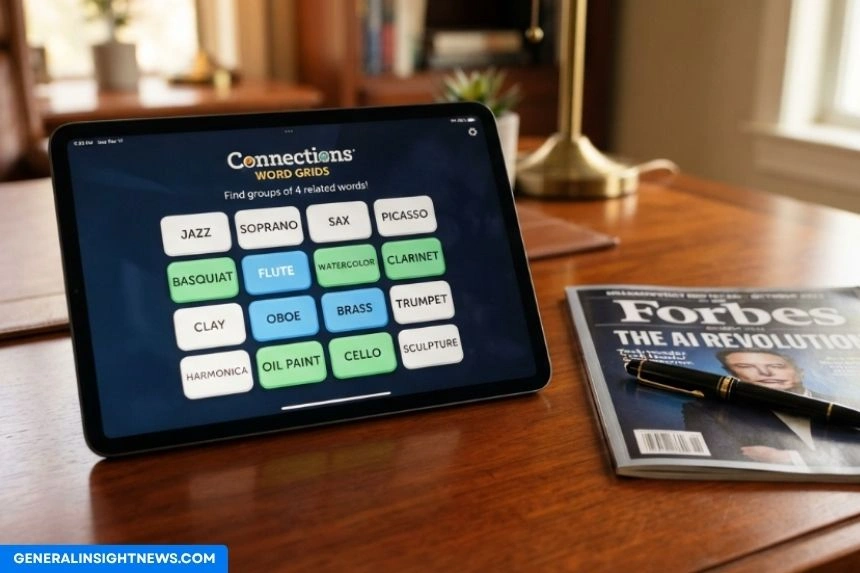
If you are searching for Connections Hint Forbes, you are probably looking for help with the daily NYT Connections puzzle. The game challenges players to sort 16 words into four groups of four, with each group sharing a hidden connection.
Forbes has published coverage of the daily NYT Connections puzzle, including hints and answers for individual dates. However, players often search for additional explanations, strategies, and reliable sources that can help them solve the puzzle without immediately revealing the solution.
This guide explains what NYT Connections is, how Forbes-style hints work, where to find official information, and how to improve your solving strategy.
What Is NYT Connections?
Connections is a word puzzle created by The New York Times. It presents players with a grid containing 16 words or short phrases.
The objective is to divide those 16 entries into four groups of four.
Each group has a common connection.
For example, four words might be connected because they are:
- Types of animals
- Names of colors
- Words that can follow a particular term
- Movie titles
- Famous people
- Items associated with a particular activity
The challenge is that many words can appear to belong to more than one possible category.
That ambiguity is one of the main reasons the puzzle is difficult.
The official New York Times Games section is the best place to play the puzzle and learn more about the game’s broader puzzle collection.
What Does “Connections Hint Forbes” Mean?
The phrase Connections Hint Forbes generally refers to searches for Forbes’ coverage of the daily NYT Connections puzzle.
Forbes has published articles that provide clues, hints, and eventually answers for particular Connections puzzles.
A typical Connections hint article may offer assistance in stages:
- General guidance
- Category hints
- More specific clues
- Full answers
- Explanations of the four groups
This format allows readers to decide how much help they want.
Someone stuck on one category can use a small clue, while another player who cannot solve the puzzle can check the complete solution.
Why Players Search for Connections Hints
NYT Connections looks simple because the board contains only 16 words.
In practice, however, the puzzle can be surprisingly challenging.
The game is designed around overlapping possibilities. A word may appear to fit one category even though the intended answer places it somewhere else.
That creates several common situations:
- You identify three words but cannot find the fourth.
- You see a category that looks correct but contains a trap.
- Several words seem to belong together.
- You find an apparent group but one word has another intended meaning.
- You make multiple incorrect guesses and lose your remaining chances.
Hints can help players move forward without completely spoiling the experience.
How the NYT Connections Game Works
The standard puzzle contains 16 entries.
You must find four groups, each containing four entries.
Once you believe you have found a group, you select the four words and submit your guess.
If your group is correct, those words are removed from the board.
If the group is incorrect, the game tells you that your selection is not correct.
Players have a limited number of mistakes, so random guessing is risky.
The official New York Times Games platform provides the current game and its interface.

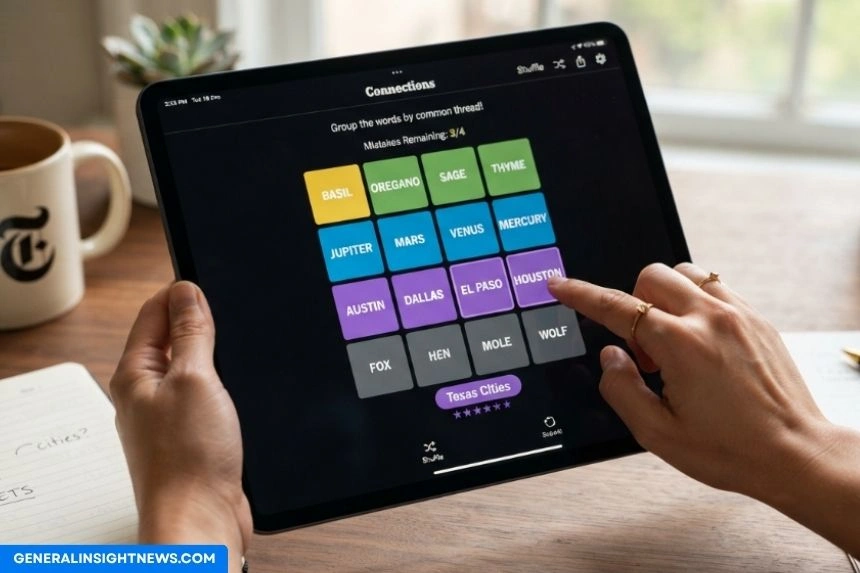
The Four Difficulty Colors
NYT Connections uses colors to communicate the relative difficulty of categories.
The categories are generally represented by:
- Yellow — easiest
- Green — moderate
- Blue — difficult
- Purple — most difficult
This color system is useful when reading or discussing Connections hints.
A hint article might describe a yellow group with a straightforward category while giving a more cryptic clue for the purple group.
However, difficulty is subjective. A category that seems obvious to one player may be the hardest part of the puzzle for another.
How Forbes Connections Hints Can Help
A Forbes Connections article can be useful when you want a structured path toward the solution.
Instead of immediately showing all 16 answers, a hint-based article can encourage readers to think about possible relationships first.
For example, a hint might tell you that a category involves:
“Things associated with a particular type of transportation.”
That clue does not reveal the four words immediately.
You still have to examine the board and determine which entries fit.
This preserves part of the solving experience.
Should You Look at the Hints or the Answers?
It depends on what you want from the puzzle.
If you want to solve everything yourself, start with no outside help.
If you are stuck, look for a broad category hint.
If you remain stuck, move to a more specific clue.
Only check the complete answers when you no longer want to solve the puzzle independently.
This approach gives you several levels of assistance.
It can also help you learn how the puzzle’s creators construct categories.
How to Solve Connections Without Spoilers
A good strategy is to avoid immediately grouping words based on the first connection you notice.
Instead, look for multiple possible relationships.
Suppose four words appear to be related to food. Before submitting them, ask:
Could one of these words also belong to another category?
That question is crucial because Connections frequently uses words with multiple meanings.
The intended category may not be the most obvious one.
Look for Strong Connections First
Start by identifying relationships that appear highly specific.
For instance, if four entries clearly represent names from the same franchise, profession, or specialized subject, that may be a stronger connection than four words that simply describe similar objects.
Strong connections reduce the number of possibilities remaining on the board.
Once one group disappears, the remaining words often become easier to interpret.
Watch for Wordplay
Some Connections categories depend on wordplay rather than meaning.
A group might consist of words that can follow the same word.
Another category could contain words that become something else when a letter is added or removed.
Some categories may involve:
- Prefixes
- Suffixes
- Homophones
- Abbreviations
- Spelling changes
- Multiple meanings
- Pop-culture references
This is why players should not assume that every category has a literal relationship.
Beware of Red Herrings
Red herrings are one of the defining features of Connections.
A red herring is a word that appears to fit a category but actually belongs elsewhere.
For example, imagine several entries that could describe colors. You might identify four color-related words and feel confident.
But one of them could have a different intended connection, leaving another word as the correct member of the color group.
This is why finding four related words is not always enough.
You need to find the intended relationship.
Use the One-Word Test
When you think you have a group, examine each word individually.
Ask:
Does this word fit the category for the same reason as the other three?
If one word fits only through a vague or unusual interpretation, reconsider the group.
The best Connections categories generally have a clear underlying rule once you see the intended answer.
Eliminate Confirmed Groups
Once you correctly identify a category, use the remaining 12 words to search for new patterns.
This dramatically reduces the number of possible combinations.
For example:
16 words → 12 words → 8 words → 4 words
The puzzle becomes progressively easier as categories are confirmed.
This is one reason solving the easiest category first can be effective.
Use the Shuffle Feature
When the arrangement of the words is confusing, shuffling the board can help.
The location of a word does not indicate its category.
A word near another entry may look connected simply because your brain naturally searches for patterns.
Rearranging the board can break that visual association and help you notice a different relationship.
Connections and Other NYT Games
Connections is part of the larger New York Times Games ecosystem.
The New York Times Games collection includes other popular games such as:
- Wordle
- Crossword
- Mini Crossword
- Spelling Bee
- Strands
- Connections
Each game uses a different type of reasoning.
Connections is particularly focused on categorization and lateral thinking.
Why Connections Became Popular
The game’s appeal comes from its simple rules and challenging logic.
Players do not need specialized knowledge to understand the objective.
You see 16 words.
You need four groups.
That is the entire basic concept.
Yet the possible combinations make the puzzle difficult enough to remain engaging.
The game also works well as a social experience because people can compare results without necessarily sharing every answer.
The New York Times has expanded its Games offerings considerably as puzzles have become an important part of its digital experience.
Connections Hints and Search Trends
Searches for terms such as Connections hint, Connections hints today, NYT Connections hints, and Connections answer today tend to increase when players become stuck on a daily puzzle.
Forbes is one publication that has covered the game through daily puzzle-related articles.
Other websites also publish hints, explanations, and solutions.
However, readers should be aware that many puzzle websites update their pages frequently. A page written for one puzzle date may not apply to another.
Always check the date before using a daily hint.
Why the Date Matters
NYT Connections changes every day.
A hint for one puzzle cannot solve another day’s board.
Therefore, when searching for:
Connections Hint Forbes
you should pay close attention to the date in the article title.
For example, a guide for September 7 is different from one for September 6.
This is particularly important because search engines may continue showing older puzzle articles after the daily puzzle has changed.
How to Find the Correct Connections Puzzle
Before reading any hints, verify:
- The date
- The puzzle number, if provided
- The 16 words on your board
- Whether the article is discussing the standard NYT Connections game
The official New York Times Games page is the safest starting point for confirming the current puzzle.
Once you confirm the date, you can look for a corresponding hint article.
Wikipedia and NYT Connections
Wikipedia can provide useful background information about the broader history of word games and The New York Times.
The New York Times Wikipedia page provides general background about the newspaper and its history.
However, Wikipedia should not be treated as the source for the current day’s Connections answers.
Daily puzzle answers are better verified through the official game itself or a reputable puzzle guide published for the correct date.
Connections Strategy for Beginners
New players can improve quickly by developing a consistent process.
Try the following:
Step 1: Scan all 16 words
Do not immediately submit anything.
Read every entry and consider unusual meanings.
Step 2: Find obvious pairs
Two words may appear connected, but remember that a category requires four.
Pairs are clues, not necessarily answers.
Step 3: Search for a third
If you find two strong matches, look for additional words that fit the same rule.
Step 4: Test the fourth
The fourth word should fit naturally.
If it requires a strange explanation, keep looking.
Step 5: Submit only when confident
Because mistakes are limited, avoid speculative guesses.
Advanced Connections Strategy
Experienced players can improve by thinking about category construction.
Ask:
What kind of category would make these four words intentionally misleading?
This changes your approach from simply looking for relationships to looking for the puzzle designer’s intended relationship.
You should also consider:
- Multiple definitions
- Cultural references
- Names
- Brands
- Abbreviations
- Titles
- Word combinations
- Spelling patterns
The purple category often rewards this kind of flexible thinking.
Common Mistakes Players Make
One of the biggest mistakes is committing to the first plausible category.
Another is assuming that categories must be based on dictionary definitions.
Players can also waste guesses by selecting four words that share only a broad theme.
For example, four words connected to sports might seem logical, but the actual category could be four terms associated with one specific sport.
Connections rewards precision.
Frequently Asked Questions
1. What is Connections Hint Forbes?
“Connections Hint Forbes” refers to searches for Forbes’ coverage of the daily New York Times Connections puzzle, particularly articles providing hints and answers.
2. What is NYT Connections?
NYT Connections is a daily word puzzle in which players organize 16 words into four groups of four based on hidden connections.
3. How many groups are in Connections?
There are four groups in each standard Connections puzzle, with four entries in every group.
4. What do the Connections colors mean?
The four colors generally represent increasing levels of difficulty: yellow, green, blue, and purple.
5. Where can I play NYT Connections?
You can play it through the official New York Times Games website.
6. Does Forbes publish Connections hints?
Forbes has published daily coverage of NYT Connections that can include clues, hints, answers, and explanations.
7. Should I check the hints before the answers?
If you want to preserve the challenge, start with the hints and only check the complete answers if you remain stuck.
8. Why are Connections puzzles difficult?
The game intentionally includes words that can appear to fit multiple categories. These misleading relationships make the puzzle more challenging.
9. Is there a Connections puzzle every day?
NYT Connections is designed as a daily puzzle, with a new board available each day.
10. Can I improve at Connections?
Yes. Practice identifying precise relationships, looking for wordplay, recognizing red herrings, and testing categories before submitting a guess.
Final Thoughts
The popularity of searches for Connections Hint Forbes reflects how challenging and engaging NYT Connections has become.
Forbes’ daily puzzle coverage can provide useful assistance when a particular board becomes difficult, while the official New York Times Games platform remains the best place to play the puzzle itself.
The best strategy is not always to find the most obvious four words. Instead, look for the most precise relationship, question potential red herrings, and avoid committing to a category until all four entries fit naturally.
Whether you use a broad hint, a category clue, or the complete solution, the real value of Connections comes from understanding why the words belong together.
Read More At General Insight News