


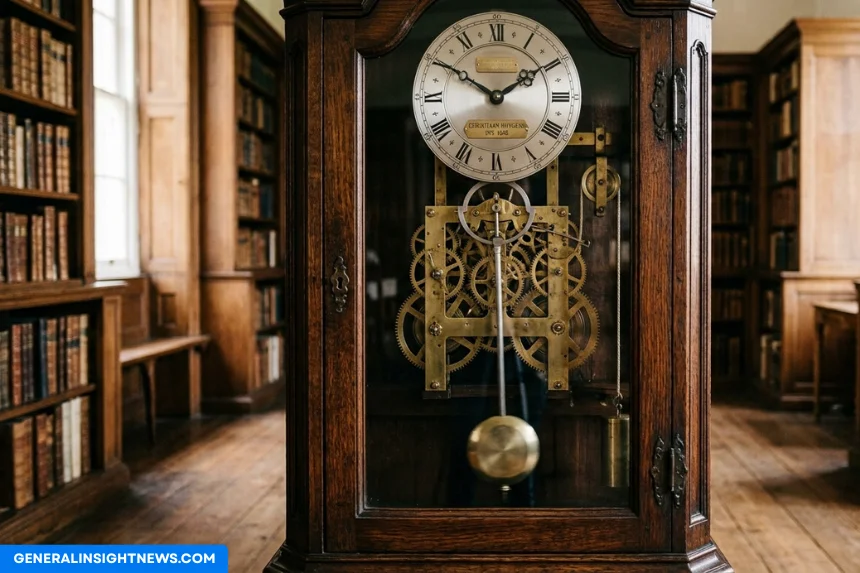
Scientific revolution inventions changed how people investigated nature. The most important examples include the telescope, compound microscope, thermoscope and early thermometer, logarithms, slide rule, astronomical micrometer, Pascaline calculator, barometer, air pump, and pendulum clock. Together, these tools helped researchers see farther, examine smaller structures, calculate faster, measure more precisely, and test ideas under controlled conditions.
However, this history is not a simple parade of lone geniuses. Several devices evolved through the work of multiple makers, and some familiar origin stories remain disputed. Therefore, the dates and attributions below distinguish firm evidence from later claims.
Scientific Revolution Inventions: Quick Answer
| Invention | Approximate date | Main attribution | What it changed |
|---|---|---|---|
| Compound microscope | Around 1590–early 1600s | Origin disputed; Dutch and Italian makers contributed | Made tiny structures visible |
| Thermoscope and early thermometer | Late 1500s–mid-1600s | Several claimants; Florentine makers developed sealed instruments | Made temperature change measurable |
| Telescope | 1608 | First firm evidence in the Netherlands; Hans Lipperhey announced one | Extended observation into the sky |
| Logarithms | 1614 | John Napier | Shortened difficult calculations |
| Slide rule | About 1622 | William Oughtred | Made multiplication and division faster |
| Astronomical micrometer | Late 1630s–early 1640s | William Gascoigne | Measured small angles through a telescope |
| Pascaline calculator | From 1642 | Blaise Pascal | Mechanized addition and subtraction |
| Mercury barometer | 1643–1644 | Evangelista Torricelli | Measured atmospheric pressure |
| Air pump | About 1650 onward | Otto von Guericke; later improved by Robert Hooke | Enabled controlled vacuum experiments |
| Pendulum clock | 1656–1657 | Christiaan Huygens | Greatly improved time measurement |
Key Facts at a Glance
| Question | Short answer |
| When was the Scientific Revolution? | A common core period is 1543–1687; broader accounts use about 1500–1700 |
| Where did it occur? | The conventional account focuses mainly on Europe and its knowledge networks |
| What made the inventions revolutionary? | They converted observations into measurements, calculations, and repeatable tests |
| Were all ten physical machines? | No. Logarithms were a mathematical calculating technique |
| Did one person invent the scientific method? | No. Experimental and mathematical practices developed through many contributors |
| Was the printing press one of these inventions? | No. European movable-type printing predates the core period, although it helped ideas spread |
Historians continue to debate the meaning and boundaries of the Scientific Revolution. Still, 1543 and 1687 form a useful frame because Copernicus’s De revolutionibus and Newton’s Principia mark major changes in astronomy and physics.
What Counts as an Invention of the Scientific Revolution?
An invention is a new device or practical technique. An improvement changes an existing device in a consequential way. By contrast, a discovery or theory describes new knowledge about nature, while an institution or practice organizes how people create and share that knowledge.
That distinction matters. Kepler’s laws of planetary motion, Harvey’s account of blood circulation, and Newton’s laws were discoveries or theories, not instruments. Likewise, the Royal Society was an institution, even though it helped researchers report experiments and examine new apparatus.
The boundaries are not perfectly rigid. Logarithms are not a metal or glass device, yet they were an invented mathematical technique that transformed scientific calculation. For that reason, they belong in a practical list of scientific revolution inventions.
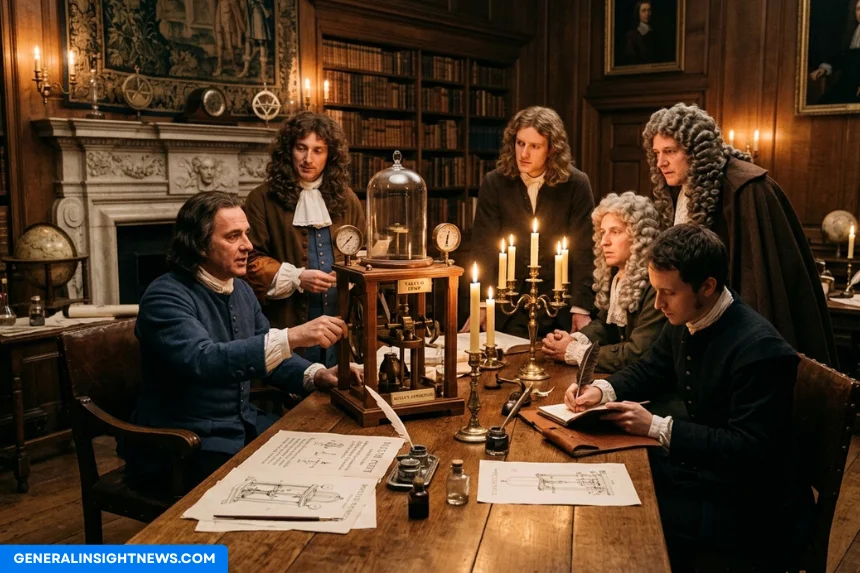
Which Scientific Revolution Inventions Expanded Human Sight?
The telescope and microscope did more than enlarge images. They exposed objects that ordinary vision could not reach and produced evidence that scholars had to explain. As a result, sight became instrument-assisted rather than limited to the naked eye.
The telescope: from Dutch device to astronomical instrument
The first firm evidence for a telescope comes from the Netherlands in 1608. Historians are not completely certain who first assembled one, but Dutch spectacle maker Hans Lipperhey announced a lens-based “seeing instrument” that year. The Royal Museums Greenwich history of the telescope explains both this evidence and the remaining uncertainty.
Galileo Galilei heard about the Dutch device in 1609. He then built more powerful versions and used them to study the Moon, Jupiter’s moons, the phases of Venus, and previously unseen stars.
Therefore, Galileo did not invent the telescope. His achievement was to improve it and turn it into a persuasive astronomical research instrument. Later, Johannes Kepler described a different lens arrangement, while Isaac Newton completed a practical reflecting telescope in 1668 to reduce color distortion caused by lenses.
The telescope changed astronomical debate by producing evidence that challenged traditional descriptions of a perfect, unchanging heaven. Nevertheless, early instruments gave narrow, imperfect views, so interpretation and quality still mattered.
The compound microscope: a disputed origin with enormous consequences
The compound microscope used two or more lenses in a tube. Its exact inventor remains uncertain. Later stories credit Zacharias Janssen or his father, Hans, while other accounts connect early microscopes to Dutch or Italian instrument makers.
Because the surviving evidence does not establish one uncontested inventor, a reliable account should not turn the Janssen story into a settled fact. The Museo Galileo’s history of the microscope instead shows a developing instrument whose name, design, and performance changed during the seventeenth century.
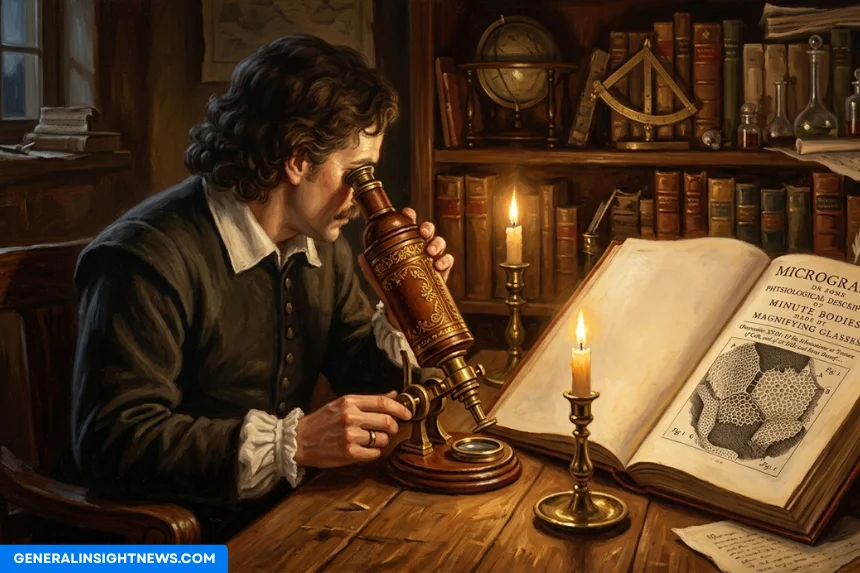
Giovanni Faber coined the term “microscope” in 1625. Subsequently, Robert Hooke used improved compound microscopes for the detailed images in Micrographia in 1665. His famous description of cork introduced the word “cell” into biology.
Antonie van Leeuwenhoek made effective single-lens microscopes and, beginning in the 1670s, reported microorganisms and other minute structures. Thus, lens quality, illumination, specimen preparation, and skilled observation all drove microscopy forward.
Which Scientific Revolution Inventions Improved Measurement?
Seeing a phenomenon was only a first step. Researchers also needed ways to compare heat, pressure, time, and angular distance. These measurement tools gave observations a numerical form that other investigators could check.
The thermoscope and early thermometer
A thermoscope showed that temperature was changing because air or liquid moved as it warmed and cooled. However, it did not necessarily have a sealed tube or a standardized numerical scale. Therefore, calling every early thermoscope the “first modern thermometer” creates a misleading shortcut.
The invention has been attributed to Galileo, Santorio Santorio, Robert Fludd, and Cornelis Drebbel. Santorio added a scale to a thermoscope, while makers associated with the Florentine Accademia del Cimento developed sealed alcohol thermometers in the mid-seventeenth century. The Museo Galileo account of this evolution emphasizes that the instrument emerged in stages.
These devices replaced variable sensations such as “hotter” and “colder” with readings that people could compare. Even so, widely adopted Fahrenheit and Celsius scales arrived in the eighteenth century.
The astronomical micrometer
In the late 1630s or early 1640s, English astronomer William Gascoigne devised a micrometer for use at a telescope’s focal point. Adjustable lines or wires allowed an observer to measure the apparent diameter of a planet or the angular distance between objects.
This was an important conceptual shift. A telescope no longer merely revealed that an object existed; paired with a micrometer, it could yield a number. Consequently, astronomers could compare observations with greater precision and use them in mathematical models.
Gascoigne died in 1644 before his design became widely known. Robert Hooke later published an account of it in Philosophical Transactions. The delayed spread also shows that an invention’s impact depends on communication, replication, and skilled manufacture.
The mercury barometer
Evangelista Torricelli created the mercury-tube experiment in 1643 or 1644. A column of mercury settled at a predictable height in a tube closed at the top, leaving an apparently empty space above it. Torricelli argued that the surrounding air supported the column.
The mercury barometer measured atmospheric pressure and challenged the traditional claim that nature could not permit a vacuum. Moreover, changes in the column connected pressure with weather.
Blaise Pascal and his brother-in-law Florin Périer strengthened the pressure explanation in 1648. Périer carried a barometer to different elevations on the Puy de Dôme and found that the mercury stood lower higher up the mountain. In this way, a portable instrument helped turn a philosophical dispute into a test with a predicted result.
The pendulum clock
Galileo studied pendulum motion and recognized its regularity. He also sketched a possible pendulum-regulated clock. However, Christiaan Huygens designed the first successful pendulum clock in 1656, and a patent followed in 1657.
The Smithsonian’s Time and Navigation project identifies Huygens with the first working pendulum clock. Its greater regularity improved timekeeping dramatically compared with many earlier mechanical clocks.
More accurate time served both research and daily life. Astronomers could time events and compare observations more reliably, while physicists could study motion with a more stable reference. In addition, improved clocks supported navigation research, although a pendulum worked poorly on a moving ship.
Which Scientific Revolution Inventions Accelerated Calculation?
New observations generated large quantities of numbers. Astronomers, navigators, surveyors, and engineers therefore needed faster ways to multiply, divide, and work with powers or roots. Logarithms, slide rules, and mechanical calculators addressed different parts of that problem.
Logarithms
Scottish mathematician John Napier published his influential logarithmic tables in 1614. Logarithms convert multiplication into addition and division into subtraction, which can greatly reduce the labor of long calculations. The MacTutor biography of Napier also describes his calculating rods, now called Napier’s bones.
Napier’s original system differed from the base-10 logarithms familiar to many students today. Henry Briggs worked with him on a more convenient form, and Briggs published extensive common-logarithm tables. Consequently, logarithms became essential tools for astronomy, navigation, and other mathematical sciences.
Calling logarithms an “invention” does not mean they were a machine. Rather, they were a deliberately constructed calculating method. Their importance lies in reducing work and lowering the chance of arithmetic errors in long numerical problems.
The slide rule
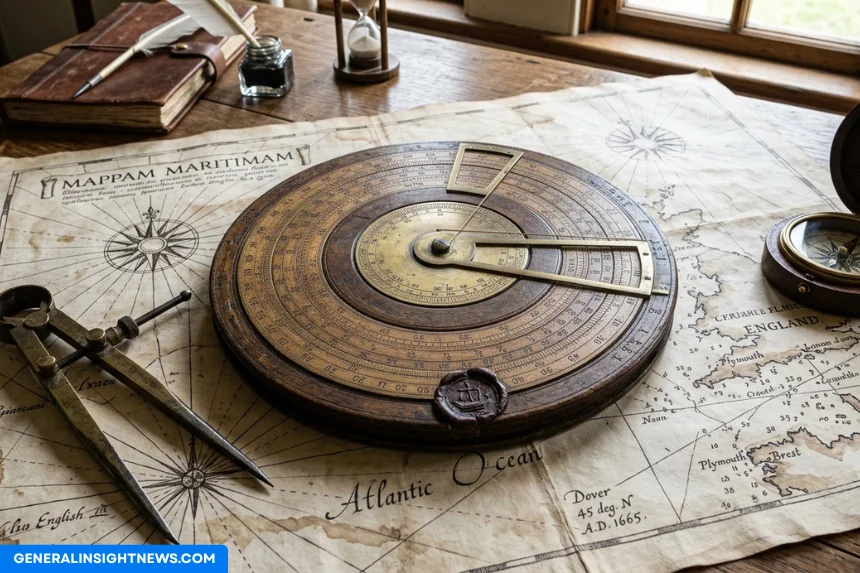
Edmund Gunter placed logarithmic values along a scale and used dividers to perform calculations. Around 1622, William Oughtred put logarithmic scales beside each other so one could slide relative to the other. This arrangement became the slide rule.
The Computer History Museum’s slide-rule history credits Oughtred with the invention in the 1620s and notes that his initial design was circular. Later makers developed familiar linear forms and added specialized scales.
A slide rule gave approximate results quickly, but the user still had to estimate the decimal point. Yet for centuries, it connected mathematical theory with scientific and engineering work.
The Pascaline mechanical calculator
Blaise Pascal began building a mechanical calculator in 1642 to help with the burdensome arithmetic involved in his father’s tax work. Rotating numbered wheels could perform addition and subtraction, while repeated operations supported multiplication and division.
According to Museo Galileo’s Pascaline history, only about 20 machines were built. The device was expensive and difficult to manufacture, so it did not become a common office tool.
Still, the Pascaline proved that a machine could carry numerical values from one digit to the next. In other words, some mental arithmetic could be embodied in a mechanism. That idea became foundational for the later history of calculating machines.
How Did the Air Pump Create a New Kind of Experiment?
Around 1650, Otto von Guericke developed a rudimentary air pump. His famous Magdeburg hemispheres demonstration showed that evacuated metal hemispheres resisted being pulled apart. The dramatic result made atmospheric pressure visible through force.
Robert Hooke later built an improved pump for Robert Boyle. Their experiments examined sound, combustion, animal respiration, and the springlike behavior of air. Because investigators could remove much of the air from a vessel, they could alter one condition and observe the effects.
The Museo Galileo history of the air pump describes its development from Guericke’s apparatus through the improved pumps of Hooke, Boyle, and later experimenters. Notably, the pump did not create a perfect vacuum. Nevertheless, it produced a controlled experimental space unlike ordinary surroundings.
The air pump also changed scientific communication. Witnesses could watch an experiment, discuss the setup, and try to reproduce it with another machine. Therefore, the apparatus helped make public demonstration and repeatability central features of experimental science.

Timeline of 10 Major Scientific Revolution Inventions
| Date | Development |
| Around 1590–early 1600s | Early compound microscopes appear; their exact origin remains disputed |
| Late 1500s–mid-1600s | Thermoscopes gain scales and evolve into sealed liquid thermometers |
| 1608 | The first firm evidence of the telescope appears in the Netherlands |
| 1614 | John Napier publishes influential logarithmic tables |
| About 1622 | William Oughtred develops the slide rule |
| Late 1630s–early 1640s | William Gascoigne develops the astronomical micrometer |
| 1642 onward | Blaise Pascal builds mechanical calculators |
| 1643–1644 | Evangelista Torricelli performs the mercury barometer experiment |
| About 1650 onward | Otto von Guericke develops an early air pump; Hooke later improves the design |
| 1656–1657 | Christiaan Huygens designs and patents the pendulum clock |
The sequence reveals a broader pattern. Optical devices expanded observation first, while numerical and experimental tools increasingly turned observations into comparable evidence. By the middle of the seventeenth century, a productive experiment often depended on both an idea and a purpose-built instrument.
What Was Not Invented During the Scientific Revolution?
The European printing press with movable metal type appeared around the mid-fifteenth century, before the usual Scientific Revolution timeline. It enabled cheaper duplication and wider circulation of books, diagrams, tables, and criticism. Thus, it was a crucial precursor rather than one of the period’s core inventions.
The “scientific method” also did not arrive as a single finished invention. Francis Bacon argued for systematic observation and induction, René Descartes emphasized disciplined reasoning, and Galileo joined mathematical analysis with experiment. Boyle, Hooke, and many others further developed practices of witnessing, reporting, and replication.
Likewise, heliocentrism, the circulation of blood, Kepler’s planetary laws, Boyle’s law, and Newton’s laws were models, discoveries, or theories. Calculus belongs to mathematics, and Isaac Newton and Gottfried Wilhelm Leibniz developed it independently. A clear account should celebrate those achievements without mislabeling all of them as machines.
How Did Scientific Revolution Inventions Change Science?
First, instruments extended human senses. Telescopes and microscopes revealed worlds that traditional texts had never described adequately. However, observers also had to learn how to judge distortion, focus, lighting, and artifacts.
Second, measurement replaced many loose comparisons with numbers. Thermometers, barometers, micrometers, and pendulum clocks made change easier to record. Consequently, researchers in different places could compare results more precisely.
Third, calculating tools made complex quantitative work more practical. Logarithms and slide rules saved time, while the Pascaline showed that mechanisms could perform arithmetic. This efficiency supported astronomy, navigation, surveying, and mechanics.
Finally, apparatus created controllable situations. The air pump let experimenters vary the presence and pressure of air inside a vessel. Combined with journals, correspondence, and scientific societies, such devices encouraged demonstrations that others could inspect and repeat.
The Scientific Revolution did not eliminate error or disagreement. Instead, it supplied new ways to locate them. A claim could now face a sharper question: What did the instrument show, how was it calibrated, and could someone else obtain the same result?
Frequently Asked Questions
1. What were the most important Scientific Revolution inventions?
The leading examples were the telescope, compound microscope, thermoscope and early thermometer, logarithms, slide rule, astronomical micrometer, Pascaline, barometer, air pump, and pendulum clock. They mattered because they expanded observation, improved measurement, accelerated calculation, or enabled controlled experiments.
2. Did Galileo invent the telescope?
No. The first firm evidence comes from the Netherlands in 1608, before Galileo built his versions in 1609. Galileo greatly improved the device and used it to make influential astronomical observations.
3. Who invented the microscope?
No single attribution is certain. The compound microscope emerged around the end of the sixteenth century or beginning of the seventeenth, and later claims credit the Janssen family, Galileo, or other makers. It is safest to describe its origin as disputed.
4. Was the thermometer invented during the Scientific Revolution?
Yes, but it evolved gradually. Early thermoscopes showed temperature change, while seventeenth-century researchers added scales and developed sealed liquid thermometers. Standard Fahrenheit and Celsius scales came later.
5. What did Evangelista Torricelli invent?
Torricelli developed the mercury barometer experiment in 1643 or 1644. It demonstrated that atmospheric pressure supported a mercury column and left a vacuum at the top of the sealed tube.
6. Who invented the pendulum clock?
Christiaan Huygens designed the first successful pendulum clock in 1656 and received a patent in 1657. Galileo had studied pendulums and proposed a clock mechanism earlier, but he did not produce the first working model.
7. Was the scientific method an invention?
Not in the same sense as a telescope or air pump. Modern scientific methods developed through the combined work of Bacon, Descartes, Galileo, Boyle, Hooke, and many others. No one person created one universal procedure.
8. Did Isaac Newton invent calculus?
Newton and Gottfried Wilhelm Leibniz developed calculus independently, using different notation and approaches. Their supporters later fought a priority dispute. Therefore, crediting Newton alone is historically inaccurate.
9. How did the printing press help the Scientific Revolution?
Printing helped scholars circulate books, diagrams, observation tables, and arguments more widely. It also made correction and comparison easier. However, the European printing press predates the conventional Scientific Revolution period.
10. How did Scientific Revolution inventions influence the Enlightenment?
They strengthened confidence that observation, measurement, calculation, and criticism could produce useful knowledge. Enlightenment thinkers extended that confidence into debates about government, economics, education, and society, although the two movements were not identical.
Conclusion
The most important scientific revolution inventions did not simply add new objects to workshops and laboratories. They changed what could count as evidence. Telescopes and microscopes extended sight; thermometers, barometers, micrometers, and clocks produced measurements; logarithms, slide rules, and calculators reduced numerical labor; and air pumps created controlled tests.
Just as importantly, these tools depended on communities of makers and observers. Their history includes disputed origins, incremental improvements, and failed designs alongside famous breakthroughs. Understanding that collaborative process gives a more accurate picture of how modern science took shape.