


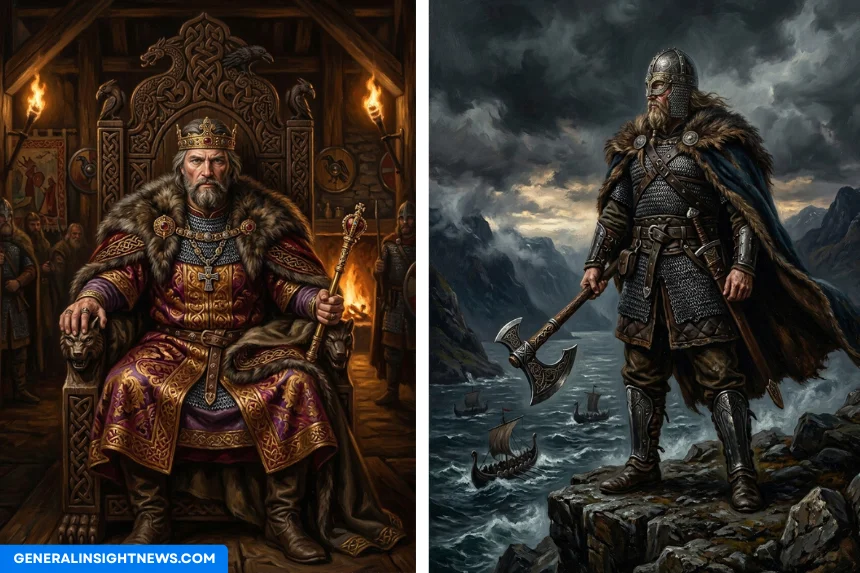
Harald Sigurdsson, better known as Harald Hardrada or Harald Hardråde, was a Norwegian warrior who rose from exile to serve in the Byzantine world, became king of Norway, fought for control of Denmark, and died invading England at the Battle of Stamford Bridge in 1066. Born around 1015, he ruled Norway jointly from about 1045–1046 and alone from 1047 until his death on September 25, 1066.
His career stretched from Norway to the lands of the Rus’, Constantinople, Sicily, Bulgaria, Denmark, and England. That extraordinary life explains why later writers turned him into the archetypal “last Viking”—and why Netflix chose Harald Sigurdsson as one of the central historical figures in Vikings: Valhalla.
Harald Sigurdsson quick facts
| Fact | Answer |
|---|---|
| Full historical name | Harald Sigurdsson |
| Better known as | Harald Hardrada / Harald Hardråde |
| Royal title | Harald III of Norway |
| Born | About 1015 |
| Exact birthplace | Not securely established |
| Father | Sigurd Syr |
| Mother | Åsta Gudbrandsdatter |
| Famous half-brother | Olaf II, Saint Olaf |
| Varangian service | Constantinople, roughly 1034/35–1043/44 |
| Wife | Ellisiv, daughter of Yaroslav the Wise |
| Long-term partner | Tora Torbergsdatter |
| Sons | Magnus Haraldsson and Olaf Kyrre |
| King of Norway | About 1045/46–1066 |
| Sole king | 1047–1066 |
| Died | September 25, 1066 |
| Place of death | Stamford Bridge, Yorkshire, England |
| Known for | Varangian career, Norwegian kingship, 1066 invasion |
| Famous nickname meaning | Roughly “hard ruler” |
Norway’s current royal king list places Harald III Hardråde between Magnus the Good and his sons Magnus II and Olaf III.
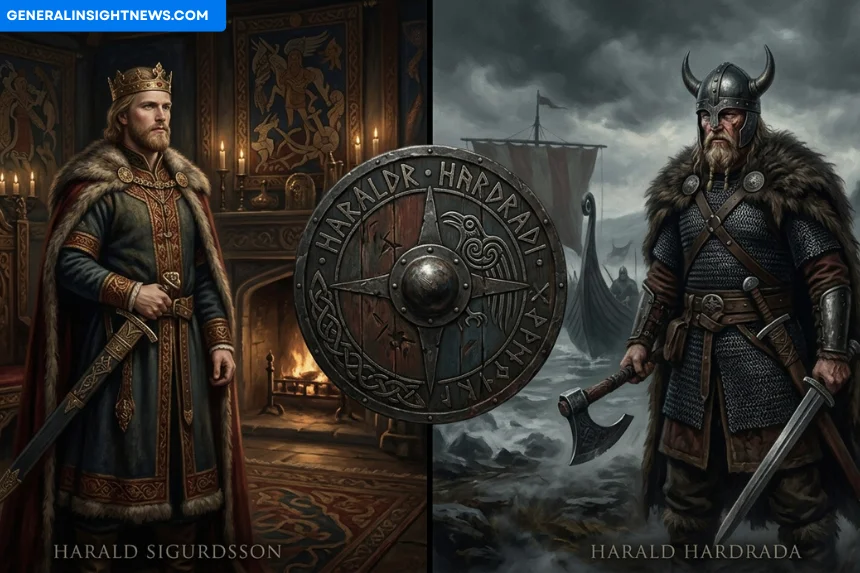
Is Harald Sigurdsson the same person as Harald Hardrada?
Yes. Harald Sigurdsson and Harald Hardrada are the same historical king.
Norwegian reference works identify him as Harald Sigurdsson, Harald III, and Harald Hardråde. The English spelling Hardrada is a conventional rendering of the Norwegian/Old Norse epithet associated with his stern or forceful rule.
His personal name was Harald.
“Sigurdsson” identifies him as Sigurd’s son, while “Hardrada” is the name by which later history remembers his character and kingship.
That distinction also explains Netflix’s choice to call the younger version of the character Harald Sigurdsson in Vikings: Valhalla. Netflix later explicitly connects him with the historical Harald Hardrada.
When was Harald Sigurdsson born?
Harald was born around 1015, although historians do not have a securely documented exact birthday.
Store norske leksikon gives 1015 while marking the year as approximate. It identifies his parents as the regional ruler Sigurd Syr and Åsta Gudbrandsdatter.
His family had important political connections in eastern Norway, especially around Ringerike.
However, an exact birthplace should not be invented. Claims that name a specific farm or settlement often depend on much later saga traditions rather than contemporary evidence.
Who were Harald Sigurdsson’s parents?
Harald’s parents were Sigurd Syr and Åsta Gudbrandsdatter.
Åsta had previously had a son, Olaf Haraldsson, who became King Olaf II and was later venerated as Saint Olaf. Therefore, Harald and Olaf were maternal half-brothers.
That relationship mattered enormously.
Harald’s connection with a reigning king gave the young warrior political status far beyond that of an ordinary Norse fighter. Later, Saint Olaf’s dynasty also strengthened Harald’s position when he returned to claim royal power.
Some modern articles incorrectly identify Harald’s mother as Estrid. Norwegian historical scholarship does not support that claim.

Was Harald descended from Harald Fairhair?
Later medieval genealogies say so, but historians treat the connection cautiously.
Saga tradition traced Sigurd Syr’s family back to Harald Fairhair, the ruler traditionally credited with unifying Norway.
However, scholars writing in Store norske leksikon note that sources from Harald Hardrada’s own lifetime do not mention that descent. They consider parts of the genealogy likely to have been constructed later.
In contrast, Harald’s relationship to Olaf II through their mother is well established.
Therefore, presenting Harald Sigurdsson as a securely documented direct descendant of Harald Fairhair gives later saga genealogy more certainty than the evidence allows.
What happened to Harald at the Battle of Stiklestad?
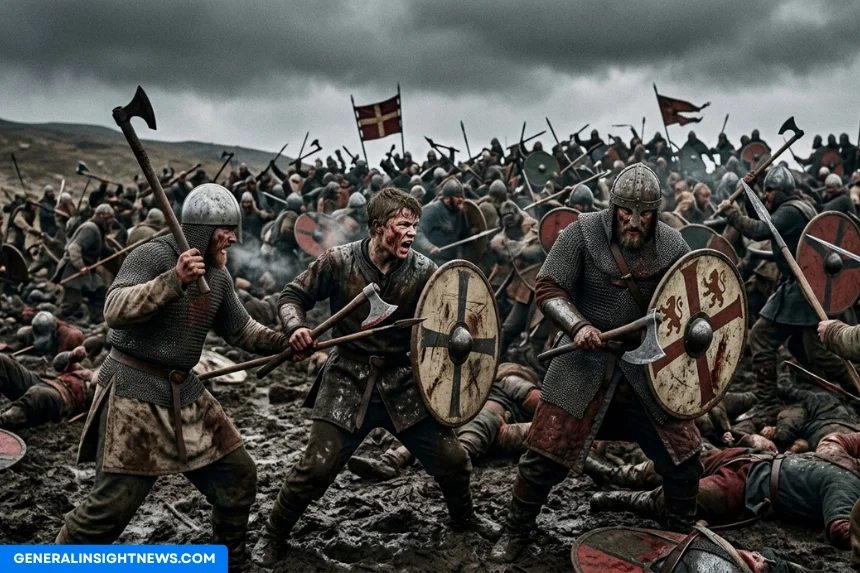
Harald fought beside his half-brother Olaf at the Battle of Stiklestad on July 29, 1030.
Olaf was trying to regain control of Norway after losing power to the political order associated with Cnut the Great. The attempt failed, and Olaf died in battle.
Harald was only about 15.
After the defeat, he escaped east. Cambridge scholarship describes him traveling through Sweden and eventually reaching the court of Yaroslav the Wise in the Rus’.
That defeat unexpectedly opened the most adventurous period of his life.
Instead of disappearing as a defeated teenage prince, Harald spent the following years building the military reputation and wealth that eventually enabled him to return to Scandinavia as a royal contender.
Did Harald Sigurdsson really live in Kyiv?
Yes. After Stiklestad, Harald spent time in the realm commonly called Kievan or Kyivan Rus’, under Yaroslav the Wise.
Norwegian historians say he spent several years with Yaroslav before traveling onward to Constantinople.
Cambridge’s The Varangians of Byzantium likewise places Harald at Yaroslav’s court and suggests that he probably held some form of military position, while warning that later claims portraying the young exile as commander of Yaroslav’s entire army are exaggerated.
That qualification matters.
Harald was already a warrior of high birth, but many spectacular details of his early career come from sagas written generations later.
Was Harald Sigurdsson really in the Varangian Guard?
Yes. This is one of the best-supported parts of his extraordinary biography.
Harald reached Constantinople around 1034 or 1035 and entered Byzantine service among the Varangians, northern European warriors associated with the emperor’s military establishment and bodyguard.
Cambridge scholarship calls Harald the best-known Norseman to serve as a Varangian and dates his Byzantine period roughly from 1034 to 1043.
A Byzantine source even refers to a figure identified as Araltes, generally connected with Harald, and indicates that he attained significant military rank.
His years in Byzantium are therefore historical, not a Netflix invention.
Where did Harald fight?
Skaldic poetry connects Harald with major campaigns including fighting in Sicily and Bulgaria.
One poet credited him with participation in 18 major battles and numerous conquests. However, historians caution that later saga writers enlarged these military traditions and added legendary material.
That leaves a strong historical core:
Harald served the Byzantine Empire, fought extensively, rose in status, and accumulated considerable wealth.
What requires more caution are the cinematic details.
Stories in which he personally dominates palace coups, blinds emperors, or becomes involved in dramatic romances with Byzantine royal women come primarily through later storytelling.
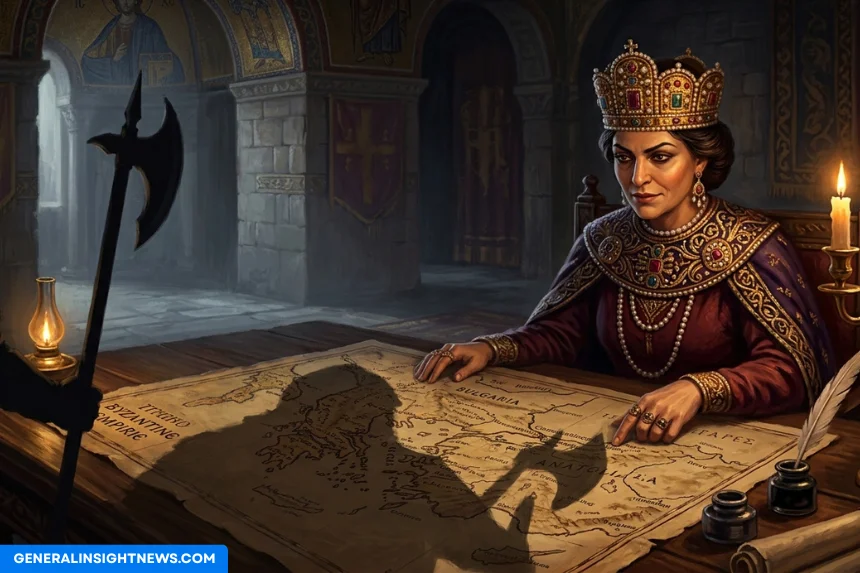
Did Harald have an affair with Empress Zoe?
No reliable evidence allows historians to state that as fact.
Later Scandinavian narratives associate Harald with Empress Zoe and other women at the Byzantine court.
However, modern Norwegian historians specifically caution that those sources romanticized his relationship with Zoe and even introduced fictional court figures into the story.
Harald did become involved in the political upheaval surrounding Constantinople in 1042.
Nevertheless, it is safer to describe him as a Varangian military figure caught up in imperial politics than as Zoe’s confirmed lover.
That difference is a good example of the broader problem with Harald’s biography: his real life was remarkable enough to generate legends, and later writers made it even more dramatic.
Why did Harald leave Constantinople?
His Byzantine career eventually ended in conflict.
Norwegian historical scholarship reports that Harald was imprisoned, probably over accusations involving imperial funds. He escaped with followers around 1043 or 1044 and returned to Yaroslav’s lands.
By then, he had accumulated substantial wealth through his years of military service.
Contemporary skaldic tradition even describes Harald’s returning ship riding unevenly because of the gold aboard.
Whether taken literally or as poetic praise, the tradition reflects an important reality: Harald came home far wealthier and more politically formidable than when he left Norway.
Who was Harald Sigurdsson’s wife?
Harald married Ellisiv Jaroslavsdatter, also known as Elisaveta or Yelisaveta, daughter of Yaroslav the Wise.
Norwegian scholarship dates the marriage to approximately 1043 or 1044, shortly before Harald returned to Scandinavia.
Later sagas attribute two daughters, Maria and Ingegerd, to Ellisiv.
However, even Norwegian historians warn that the evidence for details of Ellisiv’s later life is thin. The sources place her within Harald’s family story, but they tell us surprisingly little about her role as queen.
Harald also maintained a long-term relationship with Tora Torbergsdatter.
She became mother of his sons Magnus and Olaf, who would both inherit royal power after him.
How did Harald Sigurdsson become king of Norway?
Harald returned to Scandinavia with money, followers, royal connections, and clear political ambitions.
His nephew Magnus the Good, son of Saint Olaf, already ruled Norway.
Initially, Harald maneuvered with Magnus’s Danish enemy Sweyn Estridsson and Swedish support. That threat pushed Magnus toward a settlement with his uncle.
Harald and Magnus subsequently shared Norwegian royal power.
Sources differ slightly over whether Harald’s kingship should begin in 1045 or 1046. Norway’s official royal sequence lists 1045–1066, while other modern accounts use 1046.
The uncertainty disappears in 1047.
Magnus died that year, leaving Harald as sole king of Norway.
Why was Harald called Hardrada?
His nickname reflected his reputation for hard, forceful rule.
As king, Harald used military pressure against opponents, powerful landowners, and rebellious districts. Norwegian historians argue that the severity of his domestic rule produced the name Hardråde.
At the same time, his toughness strengthened royal authority.
That contradiction is central to his legacy.
Harald was not simply a raider who happened to wear a crown. He was an important state-building king who helped consolidate royal government in Norway.
His reign also brought disputes with the church, extensive military organization, and aggressive control over political rivals.
Therefore, “Hard Ruler” captures both the admiration and fear surrounding him.
Did Harald Hardrada conquer Denmark?
No. He repeatedly tried, but failed to make himself king of Denmark.
Harald inherited a political claim connected with Magnus the Good and spent much of his reign fighting Sweyn Estridsson.
Norwegian forces raided Danish territory, and Harald attacked important settlements including Hedeby. He also won major military encounters.
However, Sweyn retained the Danish throne.
The two kings eventually reached a settlement in 1064, ending Harald’s long attempt to dominate Denmark.
That failure matters because only two years later Harald turned his attention toward a far more ambitious target: England.
Did Harald Sigurdsson found Oslo?
Tradition says yes, but archaeology makes the story more complicated.
Later sagas credited Harald with founding Oslo, usually around the mid-11th century.
However, archaeological evidence indicates that settlement existed in the area before his reign. Store norske leksikon argues that the royal estate and St. Mary’s Church, probably dating from the mid-1000s, helped initiate substantial urban development.
Therefore, Harald may have played an important role in developing royal Oslo, but calling him the first person to establish settlement there is too simple.
This distinction is a useful example of how archaeology can refine medieval saga traditions without necessarily dismissing them completely.
Why did Harald Sigurdsson invade England in 1066?
Harald believed he had a claim to the English throne after Edward the Confessor died without children in January 1066.
Harold Godwinson became king of England, while Duke William of Normandy prepared his own invasion.
Harald Hardrada emerged as another claimant.
English Heritage describes him as a putative successor to the Scandinavian kings who had previously ruled England. He also gained the support of Tostig Godwinson, the exiled brother of King Harold.
Harald therefore sailed west with a major Norwegian fleet in September 1066.
It became the last campaign of his life.
What happened at the Battle of Fulford?
Harald and Tostig achieved an important victory before Stamford Bridge.
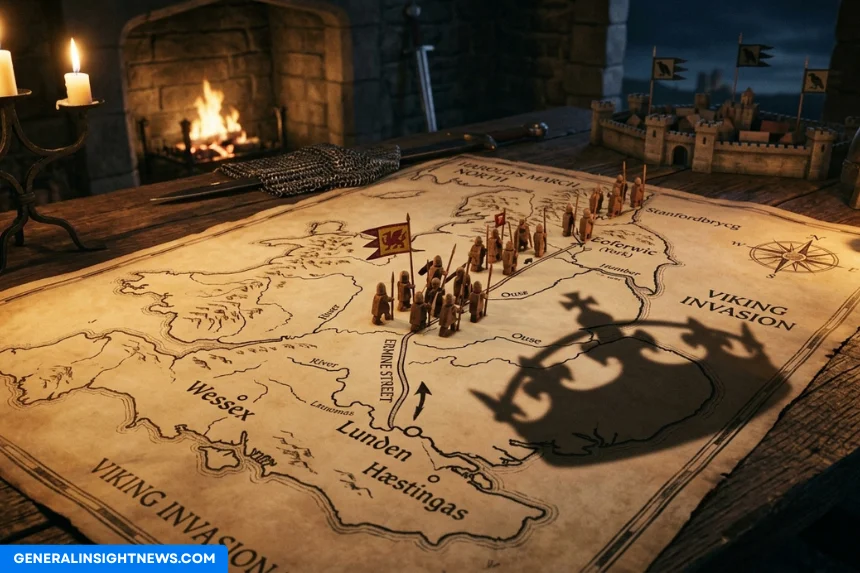
On September 20, 1066, they defeated English forces under Earls Edwin and Morcar at the Battle of Fulford, close to York.
York then submitted.
Harald appeared to be in an excellent position.
However, English king Harold Godwinson responded with extraordinary speed, moving north to confront the invaders while he still faced the possibility of William of Normandy landing in southern England.
Five days after Fulford, the situation reversed completely.
How did Harald Sigurdsson die?
Harald died at the Battle of Stamford Bridge on September 25, 1066.
King Harold Godwinson’s army surprised the Norwegian-Tostig force near York. English Heritage says many Norwegians were caught unprepared, and the ensuing battle destroyed most of Harald’s invasion army.
Harald and Tostig both died.
The traditional account says an arrow struck Harald in the throat during the fighting. English Heritage includes that story, although the exact detail comes through medieval narrative tradition rather than contemporary forensic evidence.
What is certain is the date, battle, and outcome:
Harald Sigurdsson died fighting for the English throne on September 25, 1066.
Only weeks later, Harold Godwinson would face another invasion.
William of Normandy defeated and killed him at Hastings on October 14.
Why is Harald Hardrada called the last Viking?
Harald is often called “the last great Viking” because Stamford Bridge provides a convenient symbolic endpoint for the Viking Age.
His biography fits the archetype unusually well.
He fought as a teenager, crossed Eastern Europe, served the Byzantine emperor, accumulated treasure, returned to seize royal power, raided Denmark, and died leading a seaborne invasion.
Store norske leksikon calls him the last great Viking chieftain and Viking king in Nordic history.
However, September 25, 1066 did not suddenly end Viking activity everywhere.
Modern historical scholarship treats the end of the Viking Age as a gradual process. Scandinavian kingdoms had become increasingly Christian, centralized, and integrated into wider European political structures.
Therefore, “last Viking” is a memorable historical label, not a literal claim that no Vikings existed after Harald died.
Was Harald Sigurdsson in Vikings: Valhalla a real person?
Yes. Leo Suter’s character is based on the real Harald Sigurdsson who became Harald Hardrada.
Netflix describes him as a Norwegian prince with ambitions for kingship and later follows him toward Constantinople and Varangian service. Those broad elements come from history.
However, Vikings: Valhalla is historical fiction.
Netflix itself acknowledges that timelines, relationships, plots, and characters were altered to create a dramatic story.
For example, the real Harald’s Varangian service and desire to become king have historical foundations. Nevertheless, viewers should not assume that every friendship, romance, battle sequence, or family connection depicted in the series happened as shown.
The historical Harald lived almost a thousand years ago, and much of his surviving narrative biography comes from sagas composed long after his death.
Harald Sigurdsson timeline
| Year | Event |
|---|---|
| c. 1015 | Harald Sigurdsson is born |
| 1030 | Fights beside Olaf II at Stiklestad |
| 1030s | Flees through Sweden to the Rus’ |
| c. 1034–1035 | Reaches Constantinople and enters Byzantine service |
| 1030s–1040s | Campaigns as a Varangian, including fighting connected with Sicily and Bulgaria |
| 1042 | Becomes involved in Byzantine political upheaval |
| 1043–1044 | Leaves Constantinople and returns to Yaroslav |
| c. 1043–1044 | Marries Ellisiv |
| 1045/46 | Returns to Scandinavia and becomes co-king of Norway |
| 1047 | Magnus the Good dies; Harald becomes sole king |
| 1040s–1064 | Wars repeatedly against Sweyn Estridsson for Denmark |
| 1064 | Makes peace with Sweyn |
| September 1066 | Invades England with Tostig Godwinson |
| September 20 | Wins Battle of Fulford |
| September 25 | Killed at Battle of Stamford Bridge |
Harald Sigurdsson’s historical legacy
Harald’s importance extends well beyond his spectacular death.
Norwegian historians credit him with strengthening the monarchy and consolidating Norway as a kingdom. They also emphasize his dynastic importance: later Norwegian kings for centuries descended from his line.
At the same time, he represented a changing world.
Harald could behave like the classic Viking war leader—raiding, fighting overseas, and seeking wealth—but he also ruled a Christian European kingdom, negotiated dynastic marriages, organized royal institutions, minted coins, dealt with bishops, and competed in international state politics.
That combination makes him a useful figure for understanding the transition out of the Viking Age.
He was both an heir to older Scandinavian warrior culture and a medieval monarch helping shape the Norway that followed it.
Frequently asked questions about Harald Sigurdsson
1. Who was Harald Sigurdsson?
Harald Sigurdsson was Harald III of Norway, better known as Harald Hardrada. He served as a Varangian before becoming king and died invading England in 1066.
2. Is Harald Sigurdsson the same as Harald Hardrada?
Yes. Sigurdsson identifies him as Sigurd Syr’s son, while Hardrada or Hardråde is the famous epithet associated with his hard style of rule.
3. Was Harald Sigurdsson a real Viking?
Yes, although “Viking” describes an era and type of activity more than a modern nationality. Harald fought overseas, served as a Varangian, raided Denmark, and led a seaborne invasion of England.
4. Was Harald Sigurdsson Saint Olaf’s brother?
He was Olaf II’s maternal half-brother. Their shared mother was Åsta Gudbrandsdatter, while they had different fathers.
5. Did Harald Sigurdsson serve in the Varangian Guard?
Yes. He entered Byzantine service in Constantinople around 1034–1035 and became one of the most famous Scandinavian Varangians.
6. Who did Harald Hardrada marry?
He married Ellisiv, daughter of Yaroslav the Wise, around 1043–1044. He also had a long-term relationship with Tora Torbergsdatter, mother of his sons Magnus and Olaf.
7. When did Harald Sigurdsson become king?
He became joint king of Norway around 1045–1046 and sole king after Magnus the Good died in 1047. He ruled until 1066.
8. Did Harald Hardrada found Oslo?
Later tradition credits him with founding Oslo, but archaeology indicates earlier settlement. His reign probably played an important role in the city’s mid-11th-century royal and urban development.
9. How did Harald Sigurdsson die?
He died at Stamford Bridge in Yorkshire on September 25, 1066, while invading England. Tradition says an arrow struck him in the throat during battle.
10. Is Vikings: Valhalla accurate about Harald Sigurdsson?
It uses a real historical figure and includes genuine elements such as his royal ambition, eastern travels, and Byzantine connection. However, Netflix describes the series as historical fiction and acknowledges that timelines, characters, and plots were altered for drama.
Conclusion
Harald Sigurdsson became Harald Hardrada, one of the most remarkable rulers of the Viking era. After fighting beside Saint Olaf at Stiklestad, he escaped east, served in the world of Kyivan Rus’ and Byzantium, accumulated wealth and military experience, and returned to become king of Norway.
His reign was forceful. He strengthened royal authority, fought unsuccessfully for Denmark, developed Norway’s political power, and became remembered as the “Hard Ruler.”
Then came 1066.
Harald invaded England with Tostig Godwinson, defeated northern English forces at Fulford, and died five days later at Stamford Bridge. His defeat did not literally end Viking activity, but it became one of the most famous symbolic endpoints of the Viking Age.
The historical Harald was already extraordinary without embellishment. That is also why distinguishing contemporary evidence from later saga legend—and the real king from the Vikings: Valhalla character—makes his story more interesting rather than less.
For a general reference overview, see Harald Hardrada on Wikipedia.