


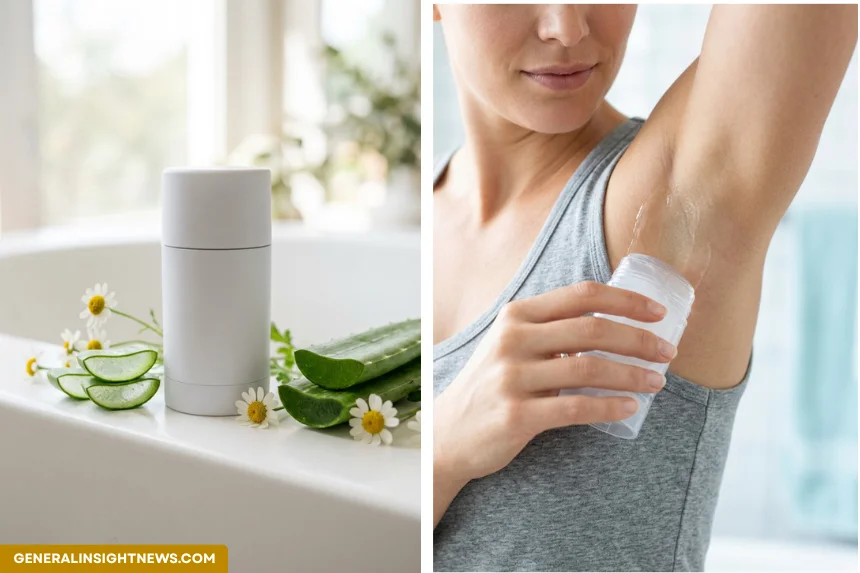
Finding a deodorant that doesn’t burn can be difficult because underarm irritation does not have one universal cause. A formula that feels comfortable for one person may cause stinging, redness, itching, peeling, or a rash for someone else.
The safest starting point is usually a fragrance-free product with a short ingredient list, no drying alcohol, and no ingredients that have caused previous reactions. It also helps to avoid applying deodorant immediately after shaving or when the skin is already sore.
Persistent burning may be a sign of irritant or allergic contact dermatitis rather than a normal response to deodorant. Fragrance is a frequent trigger, although preservatives, propylene glycol, botanical extracts, baking soda, and other ingredients can also cause problems in susceptible skin.
What Type of Deodorant Is Least Likely to Burn?
A fragrance-free deodorant or antiperspirant made specifically for sensitive skin is generally the most sensible place to start.
Look for a product that:
- Says fragrance-free, not merely unscented.
- Does not contain denatured alcohol or ethanol high on the ingredient list.
- Avoids baking soda if it has previously caused redness or soreness.
- Has a relatively short and easy-to-check ingredient list.
- Does not contain essential oils or strong botanical extracts.
- Can be applied smoothly without excessive rubbing.
- Provides the level of odour or sweat control you actually need.
“Unscented” and “fragrance-free” do not necessarily mean the same thing. An unscented product may contain ingredients that mask another smell, while a fragrance-free product should not contain added fragrance for scent or masking purposes.
No product can be guaranteed not to burn everyone. Even a hypoallergenic or sensitive-skin formula may contain an ingredient to which a particular person is allergic.
Why Does Deodorant Burn Your Armpits?
Burning usually happens because the product irritates the skin barrier or triggers an allergic reaction.
Irritant contact dermatitis
Irritant contact dermatitis occurs when an ingredient directly damages or inflames the outer layer of the skin. Burning, stinging, dryness, soreness, cracking, and peeling are common symptoms.
The risk may be higher when deodorant is applied to:
- Freshly shaved skin.
- Cuts or razor nicks.
- Skin affected by eczema.
- An existing underarm rash.
- Skin exposed to friction and heavy sweating.
- Underarms that have been scrubbed or exfoliated.
Heat, friction, and repeated exposure can make irritant contact dermatitis worse.
Allergic contact dermatitis
Allergic contact dermatitis happens when the immune system reacts to a specific ingredient. It can develop even after you have used the same product successfully for weeks, months, or longer.
Symptoms may include:
- Intense itching.
- Burning or tenderness.
- Swelling.
- A red, brown, purple, or grey rash, depending on skin tone.
- Blisters or oozing.
- Dry, thickened, or flaky skin.
Allergic reactions can take hours or days to appear, which sometimes makes the responsible product difficult to identify. Patch testing performed by a dermatologist can help identify specific allergens when reactions are persistent or recurrent.
Deodorant Ingredients That May Cause Burning
An ingredient is not automatically harmful because it appears on this list. These are simply common areas to investigate when deodorant repeatedly irritates your skin.
Fragrance
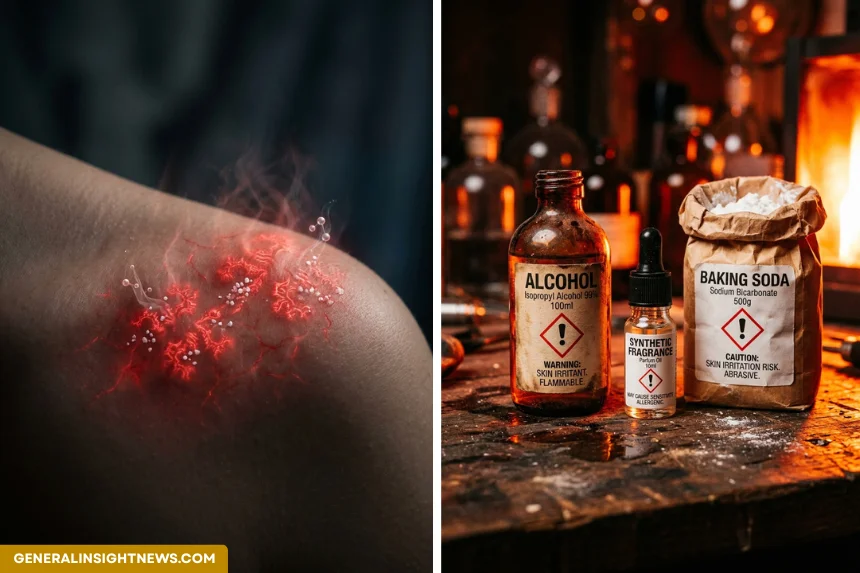
Fragrance is one of the most important ingredients to check. Deodorants are a significant source of fragrance-related allergic contact dermatitis, and the underarms are a common area for reactions to fragranced personal-care products.
Fragrance may be listed as:
- Fragrance.
- Parfum.
- Aroma.
- Essential oil.
- Individual fragrance compounds such as limonene, linalool, citral or geraniol.
A product advertised as natural can still contain several essential oils and fragrance compounds. Natural origin does not prevent an ingredient from causing irritation or allergy.
Alcohol
Alcohol can help a product dry quickly and may contribute to odour control. However, alcohol-heavy sprays, gels, and roll-ons can sting when applied to shaved, broken, dry, or inflamed skin.
Check for names such as:
- Alcohol denat.
- Denatured alcohol.
- Ethanol.
- SD alcohol.
Not every ingredient containing the word “alcohol” is equally drying. Fatty alcohols such as cetyl alcohol and stearyl alcohol are commonly used to improve texture and are chemically different from ethanol.
Baking soda
Baking soda, also called sodium bicarbonate, is commonly used in aluminium-free and natural deodorants. Some people tolerate it well, while others develop soreness, redness, itching, or peeling.
Switching to a baking-soda-free product may help when irritation began after moving to a natural deodorant. The American Academy of Dermatology advises people with particularly irritation-prone underarm conditions to avoid baking soda, alcohol, dyes, and fragrance.
Essential oils and botanical extracts
Peppermint, tea tree, citrus, lavender, rosemary, and other plant ingredients can provide scent or antimicrobial properties. They can also irritate damaged skin or cause an allergic reaction.
Do not assume that a long list of plant extracts will be gentler than a simple synthetic formula. The relevant question is whether your skin tolerates the individual ingredients.
Propylene glycol
Propylene glycol is used as a solvent, humectant, and texture-enhancing ingredient in many personal-care products. It can cause sensory irritation, irritant contact dermatitis, or, less commonly, allergic contact dermatitis.
A dermatologist may include propylene glycol during patch testing when it is suspected, particularly in people with eczema or chronically inflamed skin.
Preservatives
Preservatives keep water-containing products from becoming contaminated. They are necessary in many formulas, but a person can become allergic to a particular preservative.
Avoiding every preservative is neither practical nor automatically safer. A dermatologist can help determine whether a particular one is responsible for repeated reactions.
Is Aluminium-Free Deodorant Better for Sensitive Skin?
Not necessarily.
Aluminium-free deodorants help control odour but do not reduce sweating in the same way as antiperspirants. Antiperspirants use active ingredients, commonly aluminium salts, to reduce underarm wetness. In the United States, antiperspirant-deodorants are regulated as products that are both cosmetics and drugs, and the antiperspirant ingredient is listed separately as an active ingredient.
Aluminium may irritate some people, particularly on freshly shaved or damaged skin. However, fragrance, alcohol, baking soda, essential oils, propylene glycol, or another inactive ingredient may be the actual trigger.
An aluminium-free product can still burn if it contains an ingredient your skin cannot tolerate. Likewise, some people find a fragrance-free antiperspirant more comfortable than a heavily scented natural deodorant.
Choose according to your needs:
| Main concern | Product type to consider |
|---|---|
| Body odour without heavy sweating | Gentle aluminium-free deodorant |
| Sweat and body odour | Fragrance-free antiperspirant deodorant |
| Burning after shaving | Alcohol-free sensitive-skin stick or cream |
| Reactions to natural deodorants | Baking-soda-free, essential-oil-free formula |
| Reactions to several brands | Dermatologist evaluation and patch testing |
Sensitive-Skin Formulas Worth Checking
These examples illustrate the type of formulation to look for. They are not guaranteed to suit every person, and ingredient lists may differ between countries or change after reformulation.
Vanicream Aluminium-Free Deodorant
Vanicream currently describes its gel deodorant as fragrance-free, aluminium-free, alcohol-free, and made with five ingredients. It controls odour rather than sweat.
This type of minimal formula may suit someone who:
- Does not need antiperspirant protection.
- Reacts to fragrance or essential oils.
- Wants to avoid baking-soda-heavy natural sticks.
- Prefers a clear gel.
Vanicream Antiperspirant/Deodorant
Vanicream also markets a fragrance-free antiperspirant/deodorant for sensitive skin. It is designed to reduce wetness as well as odour.
This may be the more appropriate category when sweating and moisture contribute to friction, chafing, or odour.
Alcohol-Free Sensitive-Skin Sticks
Several mainstream brands offer sensitive-skin antiperspirant sticks described as unscented or alcohol-free. For example, Dove currently markets an unscented Advanced Care Sensitive stick with no alcohol.
Because “unscented” is not always equivalent to “fragrance-free,” check the complete ingredient list when fragrance is a known trigger.
How to Choose a Deodorant That Doesn’t Burn
1. Let the current irritation heal
Do not continue applying a product that burns. Stop using it and gently wash the area to remove the residue.
Applying one new product after another to inflamed skin makes it harder to determine which ingredients you tolerate. Wait until the underarms are calm before testing a replacement.
2. Start with fragrance-free
Fragrance-free is usually more useful than labels such as:
- Natural.
- Clean.
- Botanical.
- Dermatologist tested.
- Hypoallergenic.
- Unscented.
Those descriptions do not tell you the complete formula. Read the ingredient list rather than relying only on the front label.
3. Choose the shortest suitable ingredient list
A short formula is not automatically safer, but it gives you fewer potential triggers to investigate. It is also easier to compare products when a reaction occurs.
Photograph or save the ingredient lists of products that caused problems. Look for repeated ingredients across them.
4. Decide whether you need deodorant or antiperspirant
Choose deodorant when odour is your main concern and natural sweating does not bother you.
Choose antiperspirant when you also need to reduce moisture. Less moisture may reduce friction for some people, although stronger antiperspirants can irritate others.
5. Test the product first
The American Academy of Dermatology recommends testing a new skincare product on a small area twice daily for seven to ten days before broader use. Stop if redness, itching, swelling, burning, or another reaction develops.
A forearm test cannot perfectly reproduce the warm, moist environment of the underarm. However, it may reveal an obvious reaction before the product is applied across both armpits.
6. Apply it to clean, completely dry skin
Moisture can increase stinging and friction. Use only the amount directed on the label and avoid repeatedly rubbing a solid stick over the same area.
7. Avoid applying immediately after shaving
Shaving can create tiny cuts and temporarily weaken the skin barrier. Applying fragrance, alcohol, acids, or strong antiperspirant ingredients immediately afterward may cause burning.
Shave in the evening and apply deodorant the following morning, or leave several hours between shaving and application. Replace dull razors and use a gentle, fragrance-free shaving product.
What to Do When Deodorant Is Burning
Stop using the product immediately. Do not try to tolerate the burning in the hope that your skin will adjust.
Follow these steps:
- Wash the underarm gently with lukewarm water and a mild fragrance-free cleanser.
- Pat the area dry rather than rubbing it.
- Apply a cool compress for short periods if the skin feels hot or painful.
- Use a simple fragrance-free emollient or a thin layer of petroleum jelly if tolerated.
- Avoid deodorant, shaving, scrubs, exfoliating acids, and fragranced body products until the skin settles.
- Wear loose clothing to reduce friction.
The American Academy of Dermatology advises washing off a product that causes a reaction and notes that a cool compress or petroleum jelly may help relieve mild symptoms.
Do not apply perfume, lemon juice, apple cider vinegar, rubbing alcohol, essential oils, or strong exfoliating acids to an active underarm rash. These can cause further irritation.
When to See a Doctor or Dermatologist
Seek medical advice when the reaction is:
- Severe, painful, blistering, or widespread.
- Returning whenever you use deodorant.
- Not improving after the product is stopped.
- Producing discharge or an unpleasant smell.
- Becoming increasingly swollen or painful.
- Accompanied by fever, chills, or feeling unwell.
- Causing persistent darkening, thickening, cracking, or scarring.
Rapid worsening, discharge, increasing pain, fever, or feeling unwell can indicate an infection. Persistent, recurrent, or severe contact dermatitis should be assessed by a healthcare professional.
Get emergency help for swelling of the lips, tongue, mouth, or throat, difficulty breathing, wheezing, faintness, or rapidly spreading hives.
A dermatologist may perform patch testing to distinguish allergic contact dermatitis from irritation and identify ingredients you need to avoid.
Medical note: This information is for general education and is not a diagnosis or a substitute for personalised advice from a doctor, dermatologist, or pharmacist.
Common Mistakes to Avoid
Continuing to use a product that stings
A brief cooling sensation from a fragranced product is different from persistent burning. Pain, redness, itching, or peeling means you should stop using it.
Assuming natural means non-irritating
Natural deodorants commonly use baking soda, fragrance, essential oils, and botanical extracts. Any of these may cause irritation or allergy.
Switching only to aluminium-free products
Removing aluminium will not help when fragrance, alcohol, baking soda, or another ingredient is responsible.
Testing several products simultaneously
Trying multiple deodorants, washes, moisturisers, and treatments at the same time makes the trigger harder to identify. Introduce one new product at a time.
Applying deodorant over broken skin
Freshly shaved, scratched, or inflamed skin is more likely to sting. Wait for the skin barrier to recover.
Frequently Asked Questions
What deodorant will not burn my armpits?
No single deodorant is guaranteed to work for everyone. Begin with a fragrance-free, alcohol-free sensitive-skin formula with a short ingredient list. Avoid baking soda, essential oils, or propylene glycol when you already know you react to them.
Why does my deodorant suddenly burn?
You may have developed an allergy after repeated exposure, changed your shaving routine, damaged the skin barrier, or started using a reformulated product. Stop using it and compare its ingredient list with products you tolerated previously.
Why does deodorant burn after shaving?
Shaving removes hair but can also produce microscopic cuts and temporary skin-barrier damage. Alcohol, fragrance, acids, and antiperspirant ingredients can sting when they reach this freshly irritated skin.
Is fragrance-free deodorant better than unscented deodorant?
Usually, yes, when fragrance is the concern. Unscented products may contain masking fragrance, while fragrance-free products are intended to contain no added fragrance. Always confirm the ingredient list.
Can natural deodorant cause a chemical burn?
Natural deodorant can cause significant irritant contact dermatitis that feels and looks like a burn. Baking soda, essential oils, fragrance compounds, acids, and friction are possible triggers. A severe or blistering reaction needs medical assessment.
Should I use spray, roll-on, gel, cream, or stick deodorant?
The ingredient list matters more than the format. Sprays may contain drying alcohol or fragrance, while solid sticks may require more rubbing. Gels and roll-ons can feel gentler but may also contain propylene glycol or alcohol. Choose a texture that applies without friction and does not contain your triggers.
Does hypoallergenic mean it cannot cause a reaction?
No. Hypoallergenic does not mean allergy-proof. Test the product and stop using it if burning, redness, itching, or swelling develops.
Conclusion
The best deodorant that doesn’t burn is usually a simple, fragrance-free formula matched to your personal triggers and sweat-control needs. Start with a sensitive-skin product, avoid applying it after shaving, and test one new formula at a time.
Stop using any deodorant that causes persistent burning. Repeated reactions across several products are a reason to consult a dermatologist, who can investigate contact dermatitis and identify the specific ingredients you need to avoid.
Discover more on our website about is it good to eat orange at night