

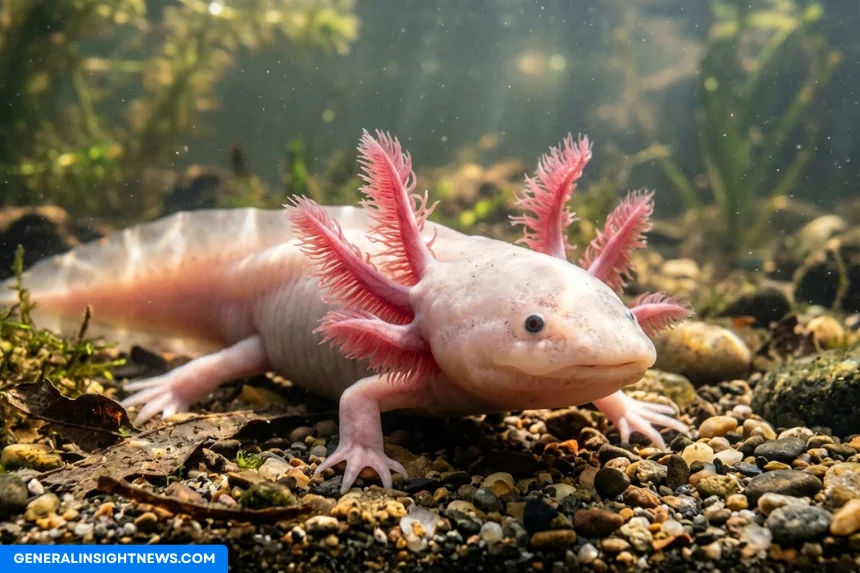
The axolotl life cycle has four main stages: fertilized egg and embryo, hatchling larva, juvenile, and sexually mature aquatic adult. Unlike many salamanders, the axolotl normally becomes an adult without losing its external gills or moving onto land.
That unusual pattern explains why people say axolotls “never grow up.” Biologically, however, they do grow up because they develop mature reproductive organs and can breed. They simply retain several features that their salamander relatives usually lose during metamorphosis.
Axolotl Life Cycle at a Glance
| Main stage | Approximate timing | Defining development |
|---|---|---|
| Fertilized egg and embryo | Fertilization through roughly 9–19 days | Cell division, body-axis formation, nervous-system development, and organ formation occur inside a jelly coat |
| Hatchling larva | Around two weeks after fertilization, depending on temperature | The larva hatches with external gills and a finned tail; limb development remains incomplete |
| Juvenile | Following weeks and months | Forelimbs, hind limbs, and digits develop while the animal grows but remains aquatic and gilled |
| Sexually mature adult | Often about 8–15 months in laboratory reports, sometimes longer | Reproductive maturity arrives without the normal terrestrial salamander metamorphosis |
These ages are estimates rather than deadlines. Temperature, food, genetics, animal density, health, and wild-versus-captive conditions all change developmental speed.
Key Axolotl Life Cycle Facts
| Category | Evidence-based fact |
| Scientific name | Ambystoma mexicanum |
| Animal type | Aquatic salamander and amphibian, not a fish |
| Native habitat | The Xochimilco wetland and canal system in southern Mexico City |
| Reproduction | Egg laying after internal fertilization through a spermatophore |
| Typical clutch description | Hundreds of individually laid, jelly-coated eggs; exact counts vary |
| Hatching | Commonly about two weeks, with published observations spanning roughly 9–19 days |
| Limb order | Forelimbs develop before hind limbs |
| Adult pattern | Reproductive adult with retained larval features |
| Scientific term | Paedomorphosis; neoteny is the familiar, narrower term |
| Normal metamorphosis | Absent from the usual life cycle |
| Longevity | Captive individuals can live for more than 10 years; wild lifespan is poorly documented |
| Wild conservation status | Critically Endangered |
How Does the Axolotl Life Cycle Begin?
The cycle begins with courtship and internal fertilization. A male deposits a small cone-shaped packet called a spermatophore on a submerged surface. The female moves over it and takes up the sperm cap through her cloaca.
Later, the female lays jelly-coated eggs one at a time, often attaching them to aquatic plants or other underwater structures. A successful spawning may produce hundreds of eggs. However, published clutch figures differ widely, so one exact number does not apply to every female or setting.
Axolotls do not guard nests or care for hatchlings after laying. Therefore, embryos and young larvae depend on suitable water, oxygen, temperature, cover, and food. In the wild, those requirements connect the reproductive cycle directly to the health of the Xochimilco wetland.
Stage 1: What Happens Inside an Axolotl Egg?
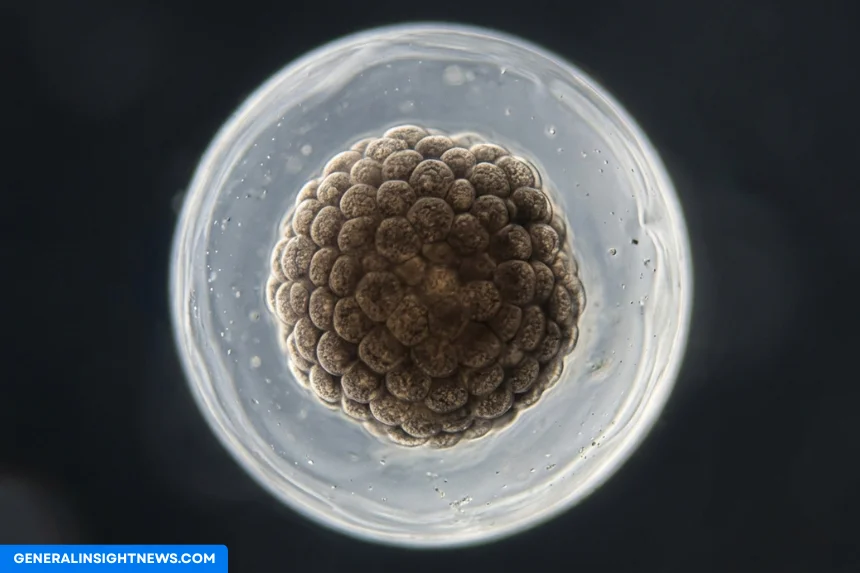
An axolotl embryo builds its basic body plan inside a clear jelly coat. Researchers identify many stages by visible anatomy rather than by age alone. The University of Kentucky embryo staging series, for example, follows numbered stages from a fertilized egg through cleavage, gastrulation, neurulation, tailbud development, and hatching.
First, cleavage divides the fertilized cell into two, four, eight, and then many smaller cells. The embryo becomes a blastula with an internal cavity. Next, gastrulation reorganizes those cells into the primary tissue layers that will produce the animal’s organs.
During neurulation, the tissue that forms the central nervous system folds into a neural tube. Meanwhile, the embryo lengthens, and the head and tail regions become recognizable. Finally, organogenesis produces increasingly visible structures, including the tail, gills, eyes, heartbeat, fin, mouth, and forelimb buds.
A 2025 UNAM-led embryology study documented 49 stages grouped into five phases. At 16°C, the researchers recorded about 350 hours from fertilization to hatching, with individual embryos ranging from 312 to 388 hours. Their review of earlier work placed total incubation at about 9–19 days, depending largely on temperature.
Consequently, “14 days” is a useful midpoint, not a guaranteed appointment. Cooler water generally slows embryo development, while warmer conditions can speed it. Still, faster does not automatically mean healthier, and a life-cycle article should not turn that relationship into a recommendation to manipulate temperatures.
Stage 2: What Is a Newly Hatched Axolotl Like?
A hatchling is a salamander larva with feathery external gills, a finned tail, a small mouth, and a body built for water. It resembles the familiar adult form, but it is not a fully developed miniature adult.
At or near hatching, the forelimbs may remain small buds, and hind-limb development is less advanced. Therefore, the larva continues building limbs and digits after it leaves the egg. Calling it a “tadpole” may help a beginner picture an aquatic amphibian larva, but tadpole properly refers to the larva of a frog or toad.
The hatchling initially relies on remaining yolk while its feeding behavior becomes established. Soon, however, it begins taking tiny aquatic prey that fits inside its mouth. Wild larvae consume zooplankton and other small invertebrates, while research colonies use carefully managed foods.
There is no post-hatching parental care. As a result, the larva must feed and avoid predators independently. Its small size makes this one of the most vulnerable periods in the cycle.
Stage 3: How Does a Juvenile Axolotl Develop?
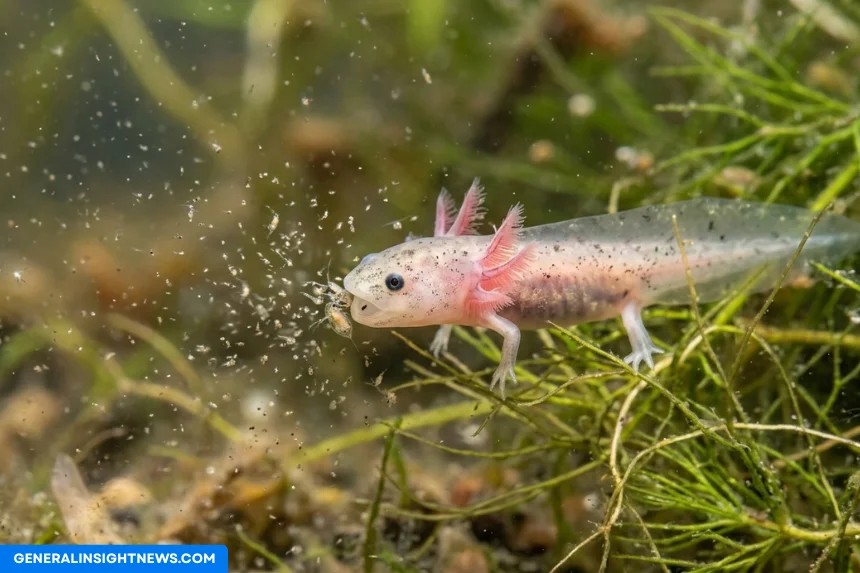
The juvenile period is a time of rapid growth and continued limb development. Forelimbs appear first; hind limbs and their digits follow. Over time, the animal acquires the four-toed front feet and five-toed hind feet associated with the familiar axolotl body plan.
Researchers use detailed morphological stages for limb growth, while keepers and laboratories also use practical labels such as larva, juvenile, and subadult. Those systems do not always draw boundaries at the same size. Therefore, “juvenile” usually means a growing animal that has moved beyond the earliest larval form but is not yet sexually mature.
Diet changes as the mouth and body enlarge. In addition, growth depends on food availability, temperature, health, genetics, and crowding. The 2024 laboratory axolotl guide from the University of Kentucky describes separate embryo, larval, juvenile, and adult categories and shows how carefully research facilities control those variables.
Length alone cannot reveal an exact age. Two axolotls from the same spawning can grow at different rates, while animals in different environments may diverge even more. Moreover, sexual maturity does not mark maximum size because an adult can continue growing at a slower pace.
Young axolotls can regenerate injured tissues, including limbs and portions of the tail. Nevertheless, regeneration takes energy and does not make injury harmless. It also does not reset the animal to an earlier life stage.
Stage 4: When Does an Axolotl Become an Adult?
An axolotl becomes an adult when it reaches reproductive maturity, not when it loses its gills. Laboratory evidence summarized in the AmphibiaWeb species account places sexual maturity around 8–15 months. Other institutional sources allow a broader range extending from roughly nine months to two years.
Conditions explain much of that variation. For example, nutrition, temperature, genetics, body condition, sex, and population density can shift the schedule. Therefore, a claim that every axolotl becomes adult at exactly six, twelve, or eighteen months is too rigid.
Mature males typically develop a more enlarged cloacal region, while mature or egg-carrying females may have a broader abdomen. However, body shape can mislead, especially before maturity. Reproductive anatomy and behavior provide better evidence than color, gill size, or a guessed age.
Adults may breed more than once during their lives. Meanwhile, they keep growing slowly and remain aquatic. Captive axolotls can live beyond 10 years, although care and individual health strongly influence longevity; reliable wild-lifespan evidence remains limited.
Why Do Adult Axolotls Keep Their Gills?
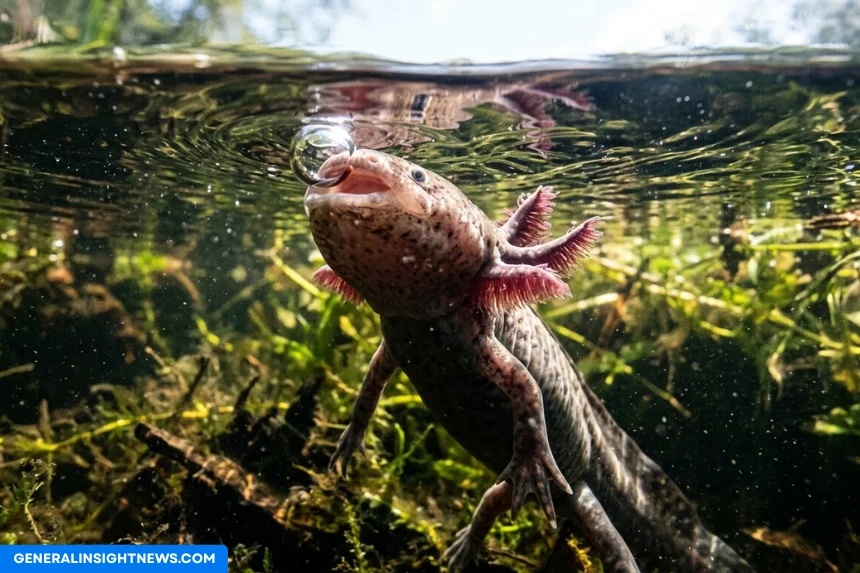
Adult axolotls retain juvenile-looking features through paedomorphosis. The popular term neoteny describes slowed development of body traits relative to reproductive development, while paedomorphosis is the broader outcome: an adult keeps traits that were juvenile in its ancestors.
Most related salamanders transform more dramatically. During metamorphosis, they may resorb external gills and the tail fin, develop more land-adapted skin and eyelids, and rely more heavily on lungs. Axolotls, instead, reach reproductive maturity while keeping their aquatic equipment.
External gills are not their only breathing surface. Axolotls can exchange gases through their skin and also have lungs, so they may rise to gulp air. Nevertheless, the normal adult remains fully aquatic and uses its gills prominently.
Scientists continue to study why this developmental schedule evolved. A review of the axolotl thyroid axis explains that paedomorphosis involves altered regulation within the hypothalamic-pituitary-thyroid system. That account is more accurate than saying axolotls simply “have no thyroid hormones.”
Can an Axolotl Metamorphose?
Metamorphosis is possible, but it is not a normal stage of the axolotl life cycle. Rare spontaneous cases have occurred in captive populations. In addition, researchers can trigger metamorphosis by administering thyroid hormone under controlled experimental protocols.
A metamorphosing animal loses or reduces its external gills and tail fin, develops eyelids and more land-adapted skin, and relies more on its lungs. However, it remains Ambystoma mexicanum; it does not turn into a tiger salamander or another species.
Induced metamorphosis can cause serious stress and may reduce survival. Therefore, owners should never attempt it with iodine, thyroid products, dietary changes, heat, poor water, or deliberate stress. A changed body shape, shrinking gills, abnormal shedding, or unexpected attempts to leave the water require advice from a qualified exotic-animal veterinarian, not an online induction recipe.
Is Regeneration Part of the Life Cycle?
No. Regeneration is a repair response, not a separate developmental stage. An axolotl may regrow a limb or repair parts of several organs, but the process does not send it back from adult to juvenile.
Moreover, regeneration does not make an axolotl immortal or immune to pain, infection, poor water quality, or aging. It matters greatly to developmental and biomedical research, yet it should remain separate from the egg-to-adult timeline.
How Does the Wild Axolotl Life Cycle Differ?
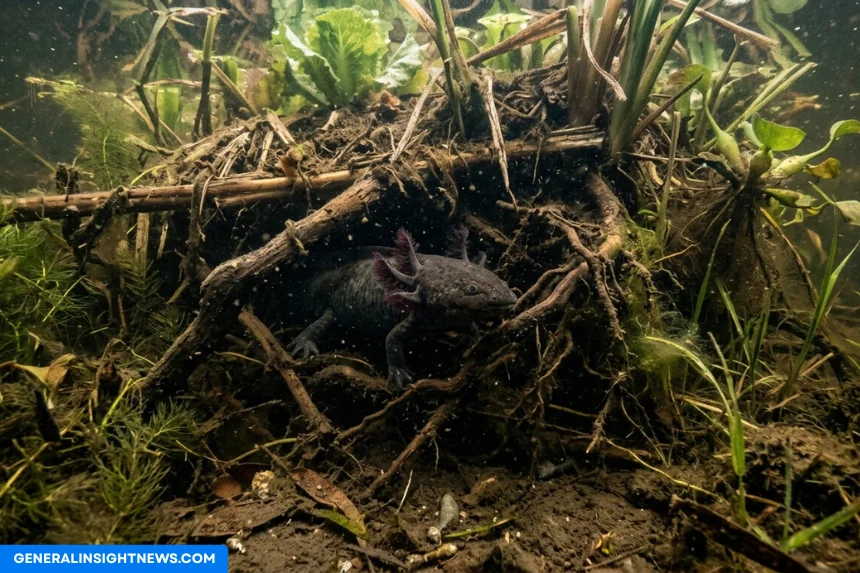
The basic stages are the same in the wild and captivity, but survival conditions differ sharply. Wild A. mexicanum now persists in a small, altered wetland system around Xochimilco. Aquatic vegetation and submerged structures provide surfaces for eggs, while cool, oxygenated water and abundant invertebrates support embryos and larvae.
However, urbanization, pollution, habitat fragmentation, and invasive fish disrupt those needs. Carp and tilapia can compete for food and eat eggs or young axolotls. Consequently, producing hundreds of eggs does not mean that hundreds of adults will join the next generation.
Most precise growth and maturity data come from laboratories because wild animals are rare and difficult to monitor. Captive colonies also experience controlled temperatures, regular feeding, and genetics shaped by long-term breeding. Therefore, laboratory timing provides a useful framework, not a perfect stopwatch for Xochimilco.
The IUCN Red List assessment published in 2020 classifies the wild species as Critically Endangered. Captive axolotls are common in research facilities and the pet trade, but their abundance does not remove the wild animal’s extinction risk.
Conservation work increasingly combines habitat restoration with carefully managed captive breeding. A 2025 wetland release study followed 18 captive-bred adults in a restored Xochimilco chinampa refuge and an artificial wetland. The animals survived and foraged during the monitoring period, which supports further habitat research; however, one small study does not prove that the wild population has recovered.
Axolotl Life Cycle Timeline
This timeline summarizes the normal sequence. Nevertheless, the ages remain approximate because an axolotl develops according to biology and environment, not a calendar alone.
| Approximate point | Stage and milestone |
| Courtship | The male deposits spermatophores, and the female takes up sperm internally |
| Hours after laying | Cleavage begins inside each jelly-coated egg |
| First several days | Blastula, gastrulation, and neurulation organize the body and nervous system |
| Remainder of incubation | The embryo lengthens; the tail, gills, eyes, heart, fin, mouth, and limb buds form |
| Roughly days 9–19 | Hatching occurs, commonly around two weeks |
| Following weeks | Feeding becomes established, forelimbs develop, and rapid growth continues |
| Following weeks to months | Hind limbs and digits form; the animal enters the practical juvenile stage |
| Often 8–15 months in laboratories | Reproductive maturity develops, although some individuals take longer |
| Adulthood | The axolotl breeds while retaining external gills, a finned tail, and an aquatic lifestyle |
| Later years | Growth slows; a captive adult may live for more than a decade |
Frequently Asked Questions
1. What are the four stages of the axolotl life cycle?
The four main stages are fertilized egg and embryo, hatchling larva, juvenile, and sexually mature adult. However, scientists divide embryonic and limb development into many more detailed morphological stages.
2. How long do axolotl eggs take to hatch?
Hatching commonly occurs about two weeks after fertilization. Nevertheless, published observations span roughly 9–19 days because temperature and other conditions affect developmental speed.
3. What does a baby axolotl look like?
A hatchling has external gills, a finned tail, and a small aquatic body. However, it is not a perfect miniature adult because its limbs and digits continue developing after hatching.
4. When do axolotls grow their legs?
Forelimb buds appear before or around hatching and continue developing afterward; hind limbs form later. Exact timing varies, so age alone cannot identify a precise limb stage.
5. How long does an axolotl take to become an adult?
Laboratory reports often place sexual maturity at about 8–15 months, although some axolotls mature later. Therefore, reproductive anatomy is more informative than a fixed birthday.
6. Do axolotls go through metamorphosis?
Not during their normal life cycle. Rare spontaneous cases occur, and scientists can induce metamorphosis with thyroid hormone, but forcing the process can harm the animal.
7. Is an adult axolotl still a larva?
An adult retains a larva-like body through paedomorphosis, but it is reproductively mature. Consequently, “adult with larval traits” is more accurate than “permanent baby.”
8. How do axolotls reproduce?
A male deposits a spermatophore, which a female takes up through her cloaca for internal fertilization. Later, she lays hundreds of jelly-coated eggs individually on underwater surfaces.
9. How long do axolotls live?
Captive axolotls can live for more than 10 years, although lifespan varies with health and care. Meanwhile, reliable longevity data for wild axolotls remain limited.
10. Is the wild axolotl life cycle different from the captive cycle?
The biological stages are the same, but growth, timing, and survival pressures differ. Wild embryos and larvae face habitat degradation, pollution, variable food, and predators, while captive animals usually live under more controlled conditions.
Conclusion
The axolotl life cycle runs from a jelly-coated egg and complex embryo to a hatchling larva, growing juvenile, and sexually mature aquatic adult. Hatching often takes about two weeks, while reproductive maturity commonly arrives within the first year under laboratory conditions but can take longer.
Most importantly, an axolotl does become an adult. It simply reaches adulthood without the usual terrestrial metamorphosis, retaining its external gills and other larval traits through paedomorphosis. That distinction makes the cycle unusual without turning biology into the misleading claim that axolotls never grow up.