


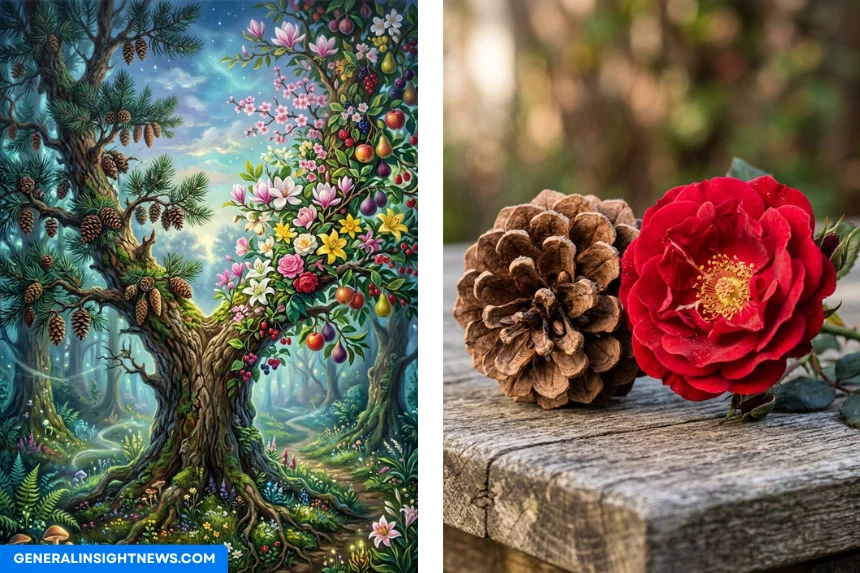
The main difference in gymnosperm vs angiosperm plants is how they organize reproduction and protect their developing seeds. Gymnosperms have ovules that are not enclosed inside an ovary, whereas angiosperms produce flowers with ovules enclosed inside an ovary; after fertilization, the ovary contributes to the fruit that surrounds the seeds.
Both groups are vascular seed plants, so they share roots, stems, vascular tissues, pollen, ovules, seeds, and a dominant sporophyte generation. However, flowers, fruits, double fertilization, reproductive structures, and several aspects of vascular anatomy distinguish angiosperms from gymnosperms.
Quick Answer: Gymnosperm vs Angiosperm
| Feature | Gymnosperm | Angiosperm |
|---|---|---|
| Gymnosperm vs angiosperm main difference | Ovules/seeds not enclosed in an ovary | Ovules enclosed in an ovary |
| Flowers | No true flowers | Yes |
| Fruit | No true fruit | Yes |
| Typical reproductive structure | Cones or other exposed ovule-bearing structures | Flowers |
| Seeds | Often called “naked” seeds | Enclosed within fruit at maturity |
| Pollination | Often wind; some animal pollination occurs | Wind, animals, water, and other mechanisms |
| Double fertilization | Not the typical angiosperm-type process | Characteristic feature |
| Nutritive seed tissue | Female gametophyte commonly nourishes embryo | Endosperm commonly nourishes embryo |
| Vascular tissue | Tracheids dominate in most groups | Tracheids and vessel elements commonly occur |
| Diversity | Roughly 1,000 living species | More than 300,000 species |
| Examples | Pine, spruce, cycad, ginkgo | Oak, rose, wheat, apple, sunflower |
The easiest memory rule is gymnosperm = unenclosed ovules; angiosperm = flowering plant with ovules enclosed inside an ovary.
What Is a Gymnosperm?
A gymnosperm is a seed plant whose ovules are not enclosed within an ovary. The name comes from Greek roots meaning “naked seed,” although botanically the crucial distinction begins with the unenclosed ovule before it develops into a seed.
Living gymnosperms include conifers, cycads, ginkgo, and gnetophytes. Conifers form the largest and most familiar group and include pines, spruces, firs, redwoods, junipers, and many other woody plants.
For a detailed university-level overview, see the OpenStax gymnosperm guide.
Do All Gymnosperms Produce Pine Cones?
No.
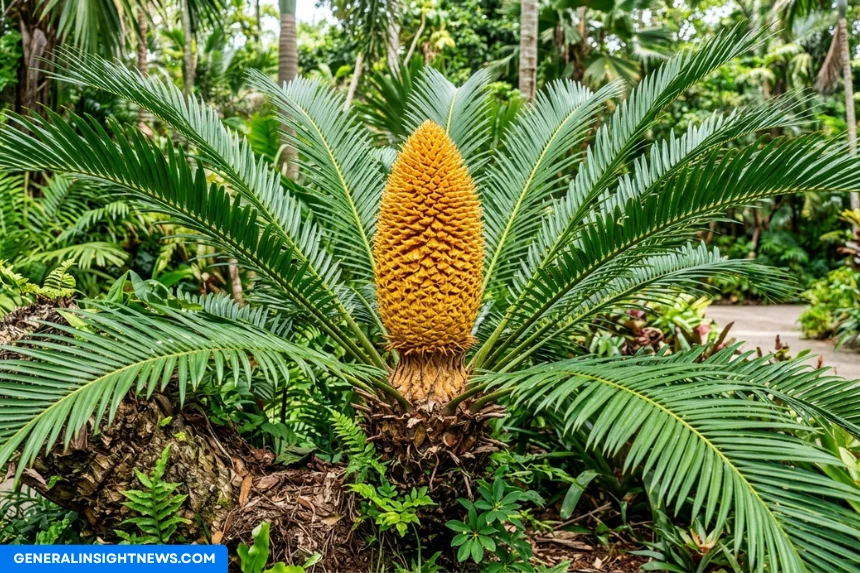
Pines provide the classic textbook example, but not every gymnosperm produces the familiar woody cone people picture. Cycads produce large reproductive structures, while ginkgo carries ovules differently.
Therefore, identifying every cone-bearing or unusual seed structure requires more than looking for something that resembles a pine cone.
What Is an Angiosperm?
An angiosperm is a flowering seed plant whose ovules develop inside an ovary. After fertilization, the ovary develops into all or part of a fruit, depending on the species.
Angiosperms include grasses, orchids, roses, sunflowers, fruit trees, oaks, maples, legumes, cacti, and nearly all major crop plants.
OpenStax reports more than 300,000 angiosperm species and describes them as the dominant plant group across most terrestrial ecosystems.
See the OpenStax angiosperm overview for a detailed treatment of flowers, seeds, fruits, and reproduction.
Does an Angiosperm Always Have an Obvious Flower?
No.
A flower does not need large petals, bright colors, or fragrance. Grasses, oaks, and many wind-pollinated plants produce flowers that people may barely notice.
Therefore, “I cannot see a colorful flower” does not mean a plant is a gymnosperm.
Gymnosperm vs Angiosperm Seed Difference
Seed enclosure provides the most important distinction.
Gymnosperm ovules remain exposed rather than sitting inside a closed ovary. In many conifers, they develop on the surfaces of cone scales.
By contrast, an angiosperm ovule sits inside an ovary. After fertilization, the ovule becomes a seed while the ovary develops into a fruit or contributes to fruit formation.
What Does “Naked Seed” Actually Mean?
“Naked” does not mean a gymnosperm seed has no seed coat.
Gymnosperm seeds still contain protective tissues. Instead, the term means the ovule and later seed do not develop enclosed within a carpel-derived ovary and true fruit.
That distinction matters because some gymnosperms produce fleshy-looking structures around seeds. A fleshy appearance alone does not turn that structure into a botanical fruit.
Flowers vs Cones
Angiosperms reproduce through flowers, while gymnosperms use other reproductive structures, often cones or strobili.
A typical flower can contain stamens that produce pollen and carpels that contain ovules. Some flowers contain both male and female structures, while other plants produce separate male and female flowers.
Gymnosperms also vary. For example, a pine commonly carries small pollen cones and larger ovulate cones on the same tree.
Are All Gymnosperms Wind-Pollinated?
No.
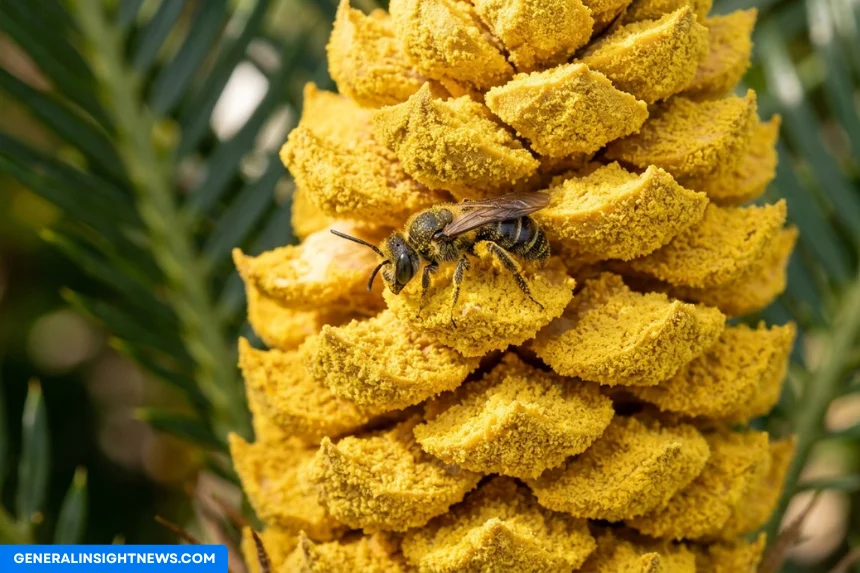
Wind pollination dominates many conifers, which can release enormous quantities of pollen. However, gymnosperm pollination is more diverse than the simple “gymnosperm equals wind” rule suggests.
OpenStax describes gymnosperms as using wind and insects for pollination. Consequently, wind is a common strategy rather than a universal requirement.
Are All Angiosperms Pollinated by Insects?
No.
Angiosperms use an extraordinary range of pollination systems. Bees, butterflies, moths, beetles, birds, bats, wind, and in some cases water can move pollen.
OpenStax notes that cross-pollination may involve physical agents such as wind or water or animals such as insects and birds.
Therefore, the gymnosperm vs angiosperm distinction does not reduce to “wind-pollinated versus insect-pollinated.”
How Does Fertilization Differ?
Angiosperms characteristically undergo double fertilization, while the familiar gymnosperm reproductive cycle follows a different pattern.
In an angiosperm, a pollen tube delivers two sperm cells into the embryo sac. One sperm joins the egg and produces the diploid zygote.
Meanwhile, the second sperm fuses with the polar nuclei in the central cell. That event produces the cell that develops into endosperm, which commonly provides nutrition for the developing embryo.
What Happens in a Gymnosperm Seed?
Using a pine as the standard model, pollen reaches the ovule and a pollen tube eventually delivers a sperm nucleus to an egg.
After fertilization, the zygote develops into an embryo. The gymnosperm seed contains the embryo, maternal seed-coat tissue, and female gametophyte tissue that can nourish the embryo.
Consequently, the nutritional tissue develops differently from the typical angiosperm endosperm.
Gymnosperm vs Angiosperm Life Cycle
Both groups show alternation of generations.
The large plant you recognize as a pine, oak, grass, rose, or cycad represents the diploid sporophyte generation. Meanwhile, the gametophytes have become highly reduced compared with those of groups such as mosses.
Both gymnosperms and angiosperms also produce pollen. Therefore, sperm can reach the egg without requiring free-standing water for sperm to swim from one plant to another, a major reproductive advantage of seed plants.
Which Has the Faster Reproductive Cycle?
It depends on the species, so no universal timing rule works.
However, some gymnosperm systems progress slowly. In pines, for example, more than a year may pass between pollination and fertilization while the pollen tube develops toward the female gametophyte.
Angiosperms include many annual plants that complete an entire life cycle within one growing season. Nevertheless, other angiosperms are long-lived trees, so “angiosperms reproduce quickly” remains a broad tendency rather than a rule.
How Do Their Vascular Tissues Differ?
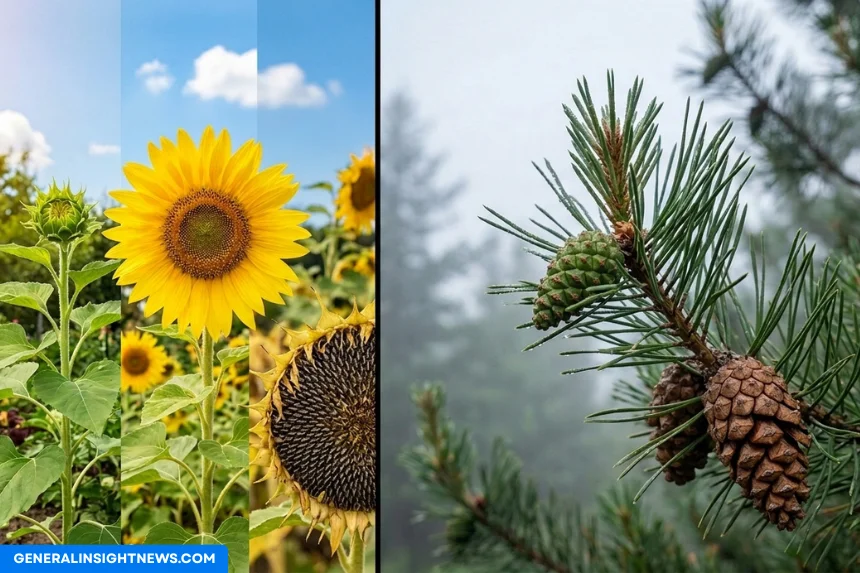
Both groups have xylem and phloem, but their conducting tissues often differ anatomically.
Most gymnosperms rely heavily on tracheids for water transport and mechanical support. By contrast, angiosperms commonly possess both tracheids and vessel elements.
However, exceptions matter.
OpenStax notes that gnetophytes, which are gymnosperms, also possess vessel elements. Therefore, “gymnosperms have no vessels” is useful only as a simplified description of many groups, not an absolute rule.
Does This Make Angiosperms “More Advanced”?
No biological lineage should simply be labeled “more advanced.”
Both groups represent successful evolutionary lineages with traits suited to different environments. Gymnosperms dominate vast boreal forests, while angiosperms dominate much of the world’s other terrestrial vegetation.
Evolution does not operate as a ladder leading from “primitive” organisms to “advanced” organisms. Instead, lineages accumulate different adaptations over time.
Are Gymnosperms Softwood and Angiosperms Hardwood?
The terms softwood and hardwood generally correspond to gymnosperm and angiosperm timber, but they do not literally tell you how hard a piece of wood feels.
Conifers supply most commercial softwoods, while broadleaf angiosperm trees supply hardwoods.
However, a hardwood species can produce relatively soft wood, and a softwood species can produce comparatively hard or dense wood. Therefore, hardness alone cannot identify the plant group.
Are Gymnosperms Always Evergreen?
No. Most familiar conifers are evergreen, but several gymnosperms lose their leaves seasonally.
Examples include larches, bald cypress, dawn redwood, and golden larch. Harvard’s Arnold Arboretum specifically lists these among deciduous conifers.
See the Arnold Arboretum conifer collection for examples.
Similarly, not every angiosperm is deciduous. Many tropical flowering trees, shrubs, and other angiosperms remain evergreen.
Gymnosperm vs Angiosperm Examples
The easiest way to understand the groups is to compare familiar plants.
| Gymnosperms | Angiosperms |
|---|---|
| Pine | Oak |
| Spruce | Maple |
| Fir | Apple |
| Redwood | Rose |
| Juniper | Sunflower |
| Cycad | Grass |
| Ginkgo | Wheat |
| Ephedra | Corn |
Notice that tree does not represent one taxonomic group. Both gymnosperms and angiosperms can grow as trees.
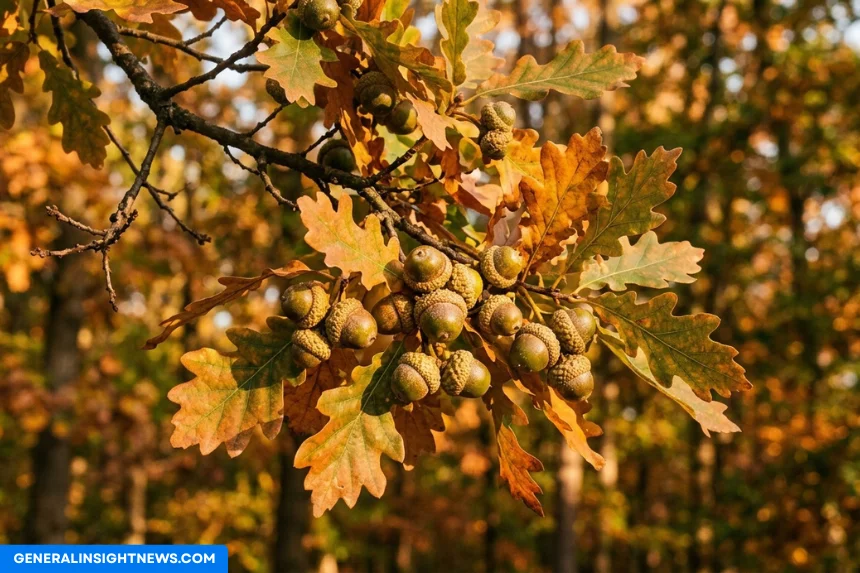
Likewise, not every angiosperm produces a fleshy edible fruit. Acorns and winged maple samaras count as botanical fruits because they develop from flower-associated ovaries.
Are Ferns Gymnosperms?
No.
Ferns are vascular plants, but they reproduce through spores rather than seeds. Therefore, they belong to neither of the two seed-plant categories.
Mosses also fall outside both groups because they do not produce seeds and lack the vascular organization of seed plants.
This distinction corrects one of the most common errors in simplified gymnosperm vs angiosperm explanations: these categories do not divide every plant on Earth.
Which Group Evolved First?
Gymnosperm lineages appeared before flowering plants and dominated many terrestrial environments during the Mesozoic.
OpenStax places gymnosperm origins in the Paleozoic and notes that they became dominant during the Mesozoic. Angiosperms appeared later and eventually became the dominant terrestrial plant group.
The exact origin of flowering plants remains an active evolutionary research topic.
When Did Angiosperms Appear?
Clear angiosperm fossils occur in the Cretaceous.
The U.S. National Park Service places the first angiosperms in the fossil record at roughly 130 million years ago, during the Early Cretaceous. Flowering plants diversified rapidly afterward.
The National Park Service plant fossil overview explains the rise of flowering plants and their spread across terrestrial ecosystems.
Because scientists continue studying possible earlier fossils and molecular timelines, articles should avoid presenting one precise date as the unquestioned moment angiosperms originated.
Why Are Angiosperms So Diverse?
Flowers, fruits, reproductive flexibility, physiological innovations, and ecological interactions all likely contributed to angiosperm diversification.
Flowers allow highly specialized interactions with pollinators. Meanwhile, fruits can protect seeds and move them through wind, water, adhesion to animals, or consumption by animals.
Improved water transport, varied growth forms, and comparatively fast reproductive cycles in many lineages may also have contributed.
However, scientists still debate exactly which combination of features best explains their extraordinary success. Smithsonian paleobotany resources explicitly note that the causes of angiosperm dominance remain an area of investigation.
For more context, see the Smithsonian flowering-plant paleobiology overview.
Similarities Between Gymnosperms and Angiosperms
Despite their differences, the two groups share several major innovations.
Both produce seeds, which protect embryos and contain resources that support early development. Both produce pollen, which transports the male gametophyte.
In addition, both contain vascular tissues and have a dominant sporophyte generation.
Therefore, the gymnosperm vs angiosperm comparison describes two related branches of seed-plant evolution rather than completely unrelated types of plants.
How Can You Identify Them Quickly?
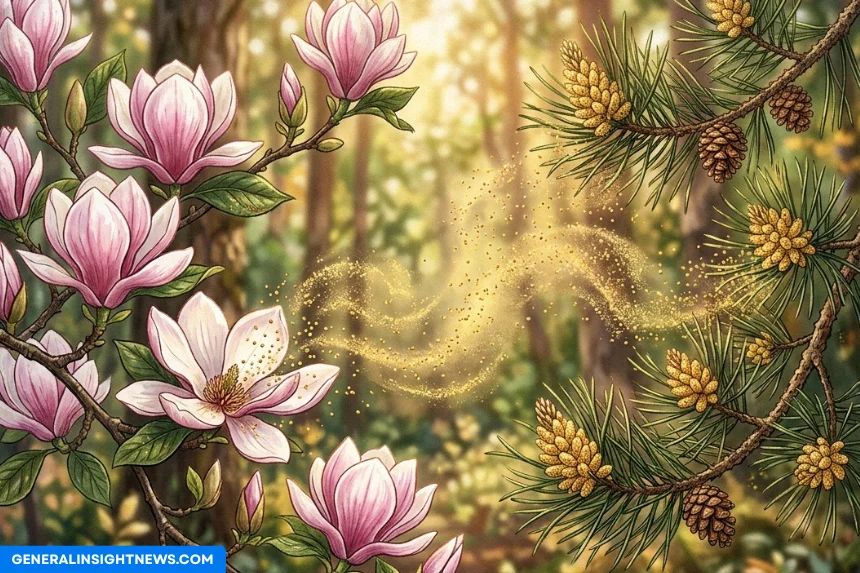
Start with reproductive structures.
If a plant produces a true flower, it is an angiosperm. If you can identify a true botanical fruit that develops from a flower, the plant is also an angiosperm.
A pine-like plant with ovules borne on cone scales will generally be a gymnosperm.
Do Not Rely Only on Leaf Shape
Needle-like leaves strongly suggest a conifer in many North American environments, but leaf shape alone can mislead you.
Some gymnosperms have broad leaves. Ginkgo provides an obvious example with its fan-shaped leaves.
Meanwhile, angiosperms show almost every imaginable leaf form.
Therefore, reproductive structures provide a better diagnostic feature than foliage alone.
Gymnosperm vs Angiosperm Study Summary
For a test, remember these four contrasts:
Gymnosperm: exposed ovule → no true flower → no true fruit → commonly cone-based reproduction
Angiosperm: ovule inside ovary → flower → fruit develops after reproduction → double fertilization
Then remember the shared features:
Both = vascular + pollen-producing + seed-producing plants
That short framework answers most introductory biology questions while avoiding common misconceptions.
FAQs About Gymnosperm vs Angiosperm
1. What is the main difference between a gymnosperm and an angiosperm?
Gymnosperms produce ovules that are not enclosed inside an ovary. Angiosperms, however, produce flowers in which the ovules sit inside an ovary that later contributes to fruit formation.
2. Do gymnosperms produce flowers?
No, gymnosperms do not produce true flowers. Instead, many use cones or other specialized reproductive structures that bear pollen or ovules.
3. Do gymnosperms produce fruit?
No, gymnosperms do not produce true botanical fruit because they lack the flower ovary from which fruit develops. However, some species have fleshy seed-associated tissues that can look fruit-like.
4. Are pine trees gymnosperms or angiosperms?
Pine trees are gymnosperms. They reproduce with pollen cones and ovulate cones, and their developing seeds are not enclosed inside an ovary.
5. Is an oak a gymnosperm or angiosperm?
An oak is an angiosperm because it produces flowers and fruits. Its acorn is a botanical fruit containing a seed.
6. Are all gymnosperms evergreen?
No. Although many conifers remain evergreen, larches, bald cypress, dawn redwood, and other gymnosperms lose their foliage seasonally. Therefore, evergreen foliage cannot define the group.
7. Are all angiosperms pollinated by insects?
No. Many use insects or other animals, but others rely on wind or water. Consequently, pollination method alone does not separate the two groups.
8. Which evolved first, gymnosperms or angiosperms?
Gymnosperm lineages appeared earlier. In contrast, clear angiosperm fossils appear in the Cretaceous, and flowering plants later became dominant across most terrestrial ecosystems.
9. Is double fertilization found in angiosperms?
Yes. In the standard angiosperm process, one sperm fertilizes the egg while another joins the polar nuclei and produces the precursor of endosperm. Therefore, two fusion events occur during reproduction.
10. Are gymnosperms and angiosperms both vascular plants?
Yes. Both contain vascular tissues that transport water, minerals, and sugars through the plant. Moreover, both belong to the seed plants and produce pollen and seeds.
Conclusion
The gymnosperm vs angiosperm distinction centers on reproductive structures. Gymnosperms produce ovules without enclosing them inside an ovary, whereas angiosperms place their ovules inside the ovary of a flower and later produce fruit.
Gymnosperms include conifers, cycads, ginkgo, and gnetophytes. Meanwhile, angiosperms include more than 300,000 flowering-plant species, from grasses and crops to roses and giant trees.
However, simple rules have limits. Gymnosperms are not all evergreen, do not all rely exclusively on wind pollination, and do not all look like pine trees. Likewise, angiosperms do not always have conspicuous flowers or fleshy fruits.
Ultimately, remember the gymnosperm vs angiosperm comparison this way: gymnosperms have unenclosed ovules, while angiosperms have flowers with ovules enclosed inside ovaries that lead to fruits.