



Today in history, July 28, marks major turning points in constitutional law, revolution, war, civil protest, aviation, natural disaster, sports, and peace efforts. On this date, Robespierre went to the guillotine in 1794, Peru proclaimed independence in 1821, the Fourteenth Amendment received formal certification in 1868, Austria-Hungary declared war on Serbia in 1914, and the IRA ended its armed campaign in 2005.
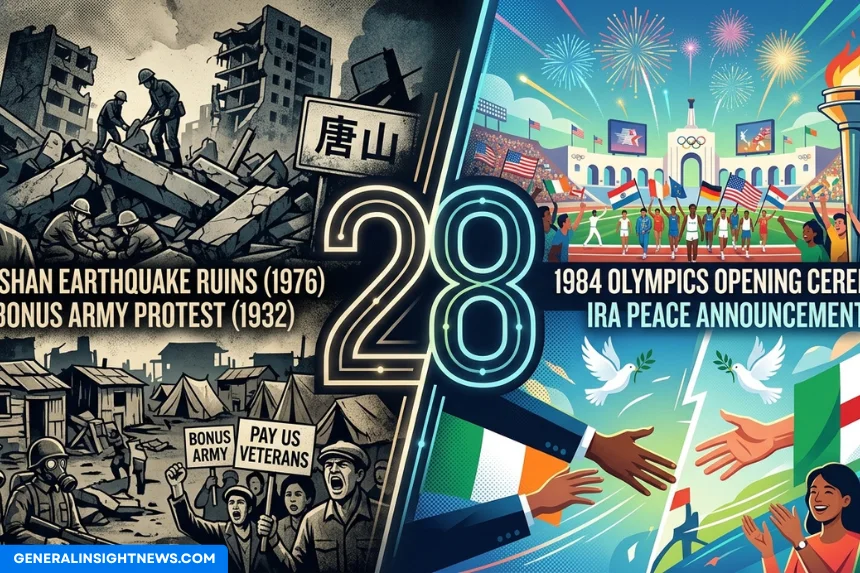
July 28 also brought tragedy. Federal troops expelled the Bonus Army from Washington in 1932, a B-25 bomber struck the Empire State Building in 1945, and the catastrophic Tangshan earthquake hit China in 1976.
For July 28, 2026, here are some of the most significant events that happened on this day.
Today in history: July 28 at a glance
| Year | What happened on July 28? |
|---|---|
| 1794 | Maximilien Robespierre was executed in Paris |
| 1821 | José de San Martín proclaimed Peru’s independence |
| 1868 | William Seward formally certified the Fourteenth Amendment |
| 1914 | Austria-Hungary declared war on Serbia |
| 1932 | Federal troops drove the Bonus Army from Washington, D.C. |
| 1945 | A B-25 bomber crashed into the Empire State Building |
| 1965 | President Johnson announced a major increase in U.S. troops in Vietnam |
| 1976 | A magnitude 7.8 earthquake devastated Tangshan, China |
| 1984 | The Los Angeles Summer Olympics officially opened |
| 2005 | The IRA ordered an end to its armed campaign |
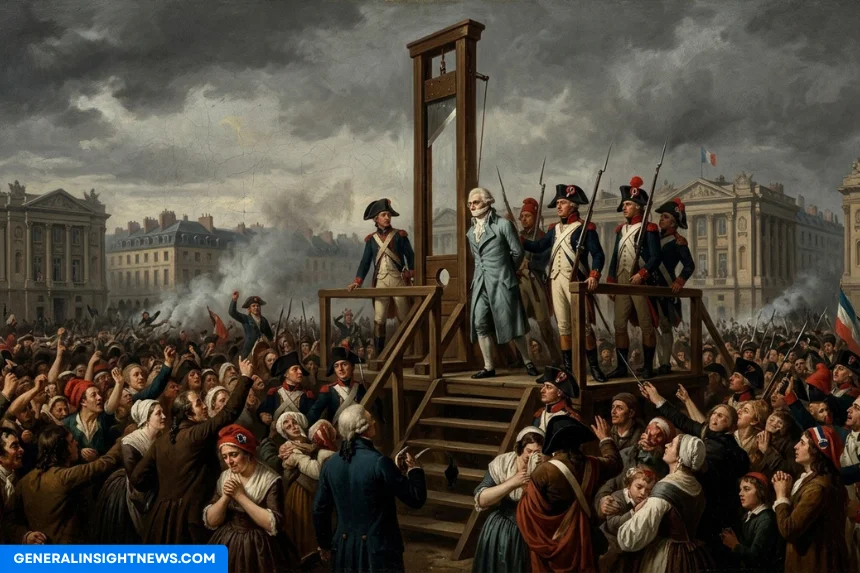
1794: Robespierre is executed during the French Revolution
Maximilien Robespierre was guillotined in Paris on July 28, 1794, after revolutionary rivals arrested him the previous day.
Robespierre had become one of the dominant political figures of the radical French Revolution and a leading member of the Committee of Public Safety.
By the summer of 1794, however, his enemies feared his growing political power and the continuing system of arrests and executions associated with the Terror.
On July 27, or 9 Thermidor in the revolutionary calendar, the National Convention ordered Robespierre’s arrest. Authorities executed him and several allies the following day.
France’s National Assembly confirms that Robespierre died on July 28, 1794 and describes his arrest and execution as the decisive political break that followed his final speech to the Convention.
The event became a symbol of the Thermidorian Reaction, when revolutionary politics moved away from the government associated with Robespierre.
1821: Peru proclaims independence
On July 28, 1821, José de San Martín publicly proclaimed the independence of Peru in Lima.
The declaration formed part of a much longer struggle against Spanish colonial rule rather than instantly ending the military conflict.
Peru’s Congress identifies July 28 as one of the culminating moments in the country’s emergence as a free and independent nation. A surviving document in Peru’s National Library also records an independence oath taken that morning.
Today, July 28 remains central to Peru’s national independence celebrations.
For a deeper look at the historical documents, the Peruvian government’s bicentennial archive identifies July 28, 1821 as the proclamation of Peruvian independence.
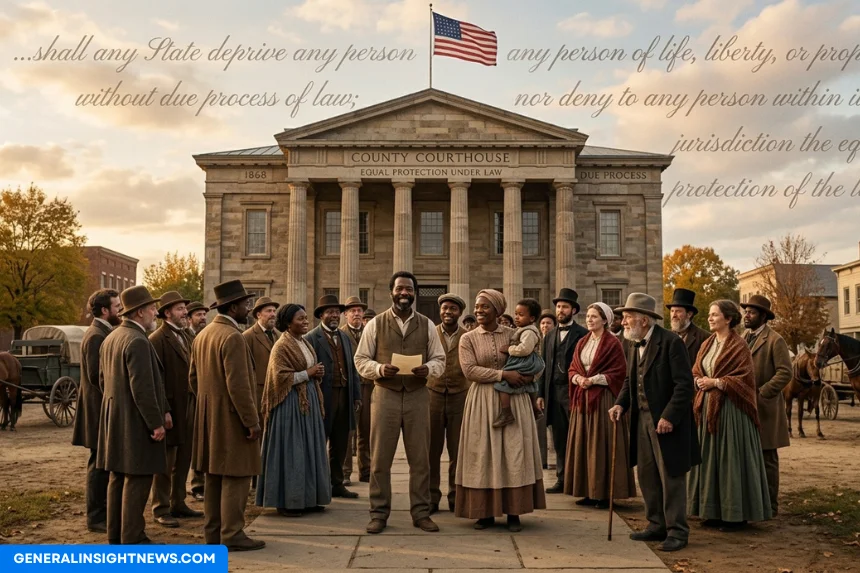
1868: The Fourteenth Amendment is formally certified
July 28, 1868, is the date Secretary of State William Seward formally certified the Fourteenth Amendment as part of the U.S. Constitution.
The distinction matters because the amendment had already reached the necessary number of state ratifications earlier in July.
The National Archives says Congress proposed the amendment in 1866 and that enough states had ratified it by July 9, 1868. On July 28, Seward issued the certification declaring that the necessary states had approved it.
The amendment establishes birthright and naturalized citizenship and prohibits states from denying due process or equal protection of the laws.
Its language later became fundamental to major civil-rights litigation and constitutional interpretation.
The Library of Congress makes the Fourteenth Amendment the lead feature of its official July 28 Today in History collection.
Library of Congress Today in History: July 28
1914: Austria-Hungary declares war on Serbia
Austria-Hungary declared war on Serbia on July 28, 1914, setting the European crisis on the path to World War I.
Exactly one month earlier, Archduke Franz Ferdinand, heir to the Austro-Hungarian throne, and his wife Sophie had been assassinated in Sarajevo.
The assassination triggered the July Crisis, during which European governments made a rapid series of diplomatic and military decisions.
Imperial War Museums records that Austria-Hungary, encouraged by Germany, declared war on Serbia on July 28. Russia’s support for Serbia then helped widen the crisis; Germany declared war on Russia on August 1 and France on August 3, while Britain entered on August 4 after Germany violated Belgian neutrality.
Therefore, July 28 is commonly treated as the formal beginning of World War I, although the transformation from regional war to wider European conflict unfolded over the following days.
Imperial War Museums: How the World Went to War in 1914
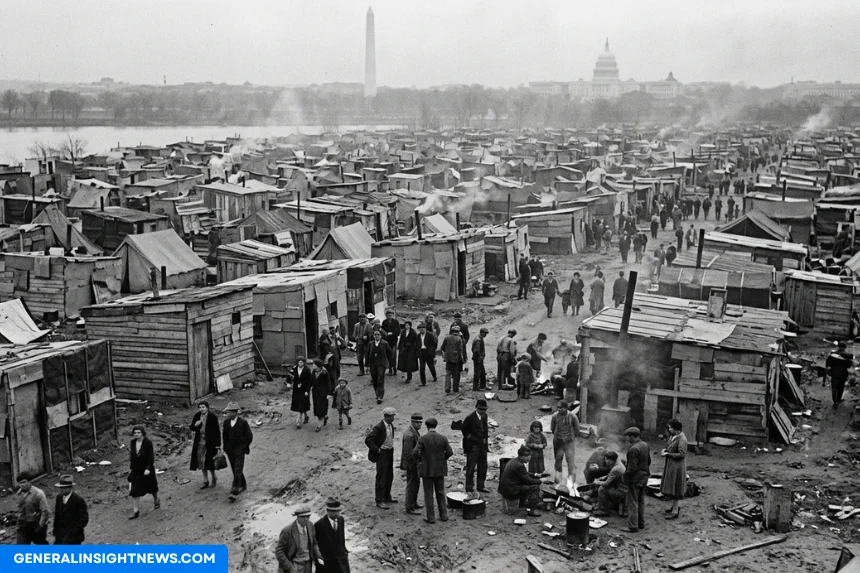
1932: The Bonus Army is forced out of Washington
On July 28, 1932, federal troops confronted and expelled World War I veterans who had gathered in Washington to demand early payment of promised bonuses.
The protesters became known as the Bonus Army or Bonus Expeditionary Force.
Congress had approved veterans’ bonuses in 1924, but payment was not scheduled until 1945. During the Great Depression, thousands of veterans and family members traveled to Washington seeking immediate payment.
President Herbert Hoover ordered federal authorities to clear the protesters. Troops operating under military commanders including Douglas MacArthur used tear gas, cavalry, infantry, and tanks as the encampments were dispersed.
The Library of Congress notes that estimates of the overall Bonus Army presence range widely—from about 20,000 to 65,000 people when families are included.
The confrontation damaged Hoover politically and became one of the most memorable protest episodes of the Depression era.
1945: A B-25 crashes into the Empire State Building
A U.S. Army B-25 bomber crashed into the Empire State Building on July 28, 1945, during dense fog over New York City.
The aircraft struck the north side of the skyscraper around the 79th floor.
According to the Library of Congress, three crew members and 11 office workers died, for a total of 14 fatalities.
The collision punched a large opening into the building and ignited fires fueled by aviation gasoline. Nevertheless, the building’s structure survived.
A National Park Service landmark record describes the crash as one of the most severe tests the skyscraper’s construction ever faced.
Some modern “on this day” pages give a death toll of 13. However, the Library of Congress figure of 14 provides the stronger federal-source count for this article.
1965: Lyndon Johnson expands U.S. forces in Vietnam
President Lyndon B. Johnson announced a major increase in American troop levels in Vietnam on July 28, 1965.
Speaking at a White House news conference, Johnson defended U.S. involvement in Vietnam and outlined a larger military commitment.
The American Presidency Project’s presidential timeline records that Johnson increased the planned number of U.S. troops in Vietnam from 75,000 to 125,000 on July 28.
The announcement came during a pivotal year in the Americanization of the Vietnam War.
Although U.S. military involvement had developed over previous administrations and had already accelerated under Johnson, the summer 1965 decisions signaled a much larger ground commitment.
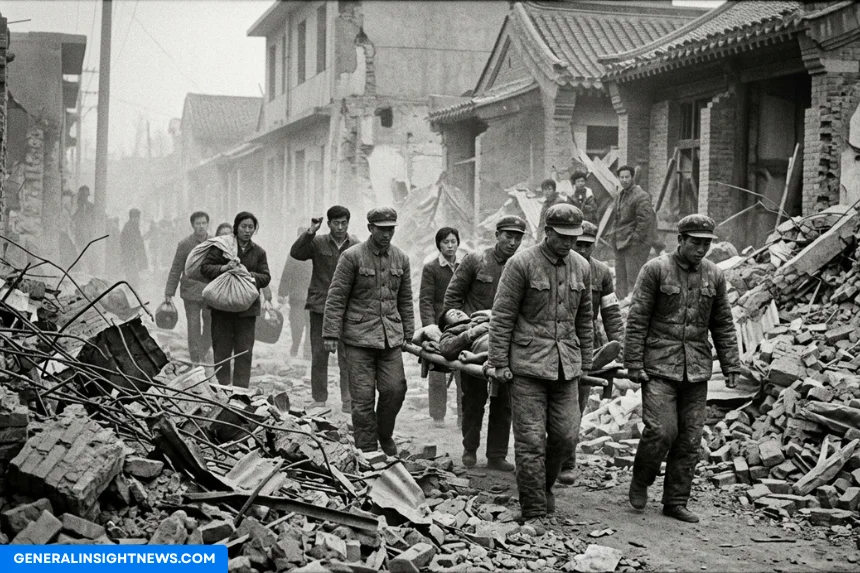
1976: The Tangshan earthquake devastates China
At 3:42 a.m. local time on July 28, 1976, a magnitude 7.8 earthquake struck the heavily industrialized Chinese city of Tangshan.
The U.S. Geological Survey records a focal depth of about 15 kilometers and describes catastrophic destruction across the city.
The disaster became one of the deadliest earthquakes in modern history.
USGS later cited an official death count of approximately 240,000 people, while noting that early estimates after the disaster ranged much higher. The exact human toll remains difficult to establish with precision.
Consequently, trustworthy summaries should avoid presenting the highest early estimates as universally accepted totals.
U.S. Geological Survey: The 1976 Tangshan Earthquake
1984: The Los Angeles Summer Olympics open
The Games of the XXIII Olympiad officially opened in Los Angeles on July 28, 1984.
The opening ceremony took place at the Los Angeles Memorial Coliseum, which had also hosted Olympic ceremonies in 1932.
A July 28 publication preserved by the LA84 Foundation describes the day as the opening of the Games after five years of planning and says more than 140 nations and approximately 7,800 athletes were expected to participate.
The Los Angeles Games became particularly important in Olympic history for their commercial organization, extensive use of existing venues, and long-term financial legacy.
Contemporary ticket materials also confirm July 28 as the scheduled date for the opening ceremony.
2005: The IRA announces the end of its armed campaign
On July 28, 2005, the Provisional Irish Republican Army formally ordered an end to its armed campaign and instructed its units to pursue political goals through peaceful means.
The announcement came seven years after the 1998 Good Friday Agreement and represented another major step in Northern Ireland’s peace process.
The archived IRA statement ordered an end to the armed campaign effective that afternoon and directed members toward “exclusively peaceful means.”
British Prime Minister Tony Blair and Irish Taoiseach Bertie Ahern welcomed the announcement while stressing that implementation and independent verification remained essential.
In September 2005, the Independent International Commission on Decommissioning announced completion of IRA weapons decommissioning.
Therefore, July 28, 2005, represents a crucial political milestone, though it should not be confused with the earlier Good Friday Agreement itself.
A famous July 28 birthday: Jacqueline Kennedy Onassis
Jacqueline Bouvier Kennedy Onassis was born on July 28, 1929.
She later became First Lady of the United States during John F. Kennedy’s presidency and played a major role in preserving and presenting the history of the White House.
The Library of Congress notes that she established a White House Fine Arts Commission, helped acquire historic furnishings, and hosted the first televised tour of the White House in 1962.
After President Kennedy’s assassination, she remained one of the most recognizable American public figures of the twentieth century.
She later married Aristotle Onassis and built a publishing career before her death in 1994.
Why July 28 is an unusually important date
July 28 connects several very different kinds of history.
The execution of Robespierre marks the collapse of one revolutionary political order. Peru’s 1821 proclamation represents national independence. The Fourteenth Amendment shaped American citizenship and civil rights.
Meanwhile, July 28, 1914, sits at the center of the diplomatic chain that opened World War I.
Later July 28 events show different forms of crisis: veteran protest during the Great Depression, wartime-era aviation tragedy in New York, escalation in Vietnam, and one of history’s deadliest earthquakes.
Then, the 1984 Olympics and 2005 IRA announcement demonstrate how the same calendar date also carries stories of international cooperation, sport, and political transition.
How should “today in history” facts be checked?
Date lists are useful for discovery, but a historical event should ideally be checked against archival, government, museum, academic, or primary sources.
That approach matters because simple timeline entries can hide important distinctions.
For example, saying “the Fourteenth Amendment was ratified July 28” misses the fact that the ratification threshold had already been reached on July 9 and July 28 was the certification date. Likewise, casualty counts for disasters and accidents often differ between sources.
The Library of Congress explains that its own Today in History feature uses materials from its digital collections and that reference staff fact-check and update its essays.
For readers who want a broad calendar overview beyond this curated article, July 28 on Wikipedia can provide additional names and events, while primary and institutional sources remain stronger for verification.
Frequently asked questions about today in history
1. What happened today in history on July 28?
Major July 28 events include Robespierre’s execution in 1794, Peru’s independence proclamation in 1821, certification of the Fourteenth Amendment in 1868, and Austria-Hungary’s declaration of war on Serbia in 1914.
2. Did World War I start on July 28, 1914?
Austria-Hungary declared war on Serbia on July 28, formally starting the conflict between the two states. However, the wider European war developed over the following days as Russia, Germany, France, Britain, and other powers became involved.
3. What happened with the Fourteenth Amendment on July 28?
Secretary of State William Seward certified the Fourteenth Amendment as part of the Constitution on July 28, 1868. The necessary number of states had already reached the ratification threshold earlier that month.
4. What was the Bonus Army event on July 28, 1932?
Federal troops cleared World War I veterans and their supporters from Washington after they demanded early payment of promised bonuses. The confrontation became a major political episode of the Great Depression.
5. Did an airplane hit the Empire State Building on July 28?
Yes. A B-25 bomber struck the Empire State Building on July 28, 1945, in heavy fog. The Library of Congress records 14 deaths, including three crew members and 11 people in the building.
6. What happened in Vietnam on July 28, 1965?
President Lyndon Johnson announced an increase in U.S. troop strength in Vietnam from 75,000 to 125,000. The announcement represented an important escalation of American military involvement.
7. What major earthquake happened on July 28?
The Tangshan earthquake struck China on July 28, 1976. USGS records a magnitude of 7.8 and an official death toll of roughly 240,000, although historical estimates have varied.
8. Which Olympics began on July 28?
The 1984 Summer Olympics officially opened in Los Angeles on July 28. The Los Angeles Memorial Coliseum hosted the opening ceremony.
9. Who was born on July 28?
Jacqueline Bouvier Kennedy Onassis was born July 28, 1929. She later served as U.S. First Lady during President John F. Kennedy’s administration.
10. What happened on July 28, 2005?
The IRA formally ordered an end to its armed campaign and directed members toward exclusively peaceful political activity. The announcement became an important milestone in Northern Ireland’s peace process.
Conclusion
Today in history, July 28, brings together events that transformed nations, governments, wars, cities, and political movements.
Robespierre’s execution reshaped the French Revolution. Peru proclaimed independence. The United States formally certified the Fourteenth Amendment, while Austria-Hungary’s declaration of war on Serbia opened the military crisis that became World War I.
Later, July 28 witnessed the Bonus Army confrontation, the Empire State Building B-25 crash, U.S. escalation in Vietnam, the Tangshan earthquake, the opening of the 1984 Los Angeles Olympics, and the IRA’s 2005 announcement ending its armed campaign.
Taken together, these events show why a useful today in history page should do more than list dates. The context behind each date explains why people still remember it.