



Tyna Robertson, also identified in court records as Tyna Karageorge, is a private individual best known as the former partner of retired NFL star Brian Urlacher and the mother of their son, Kennedy Urlacher. Her name has appeared in public reporting mainly because of family-court disputes and separate civil litigation, not because she has maintained a conventional entertainment or sports career.
However, many online profiles go further than the reliable record supports. Her exact birth date, birthplace, education, present occupation, current residence, relationship status, and net worth have not been authoritatively confirmed. Therefore, an accurate account must distinguish documented facts from allegations, old news reports, and unsupported biography claims.
This article explains the public record in plain language. It also updates Kennedy Urlacher’s college-football status and clarifies what courts did—and did not—decide in the cases most often linked to Robertson’s name.
Tyna Robertson Quick Answer
| Question | Verified answer |
|---|---|
| Who is Tyna Robertson? | A private individual known publicly as Brian Urlacher’s former partner and Kennedy Urlacher’s mother |
| Other name in records | Tyna Karageorge; a federal order identifies her as formerly known as Tyna Robertson |
| Was she married to Brian Urlacher? | No; they were former partners and share a son |
| Publicly verified son | Kennedy Urlacher |
| Kennedy’s current team | USC Trojans, according to USC’s 2026 spring football roster |
| Reported former occupation | A 2007 established-news report described her as a real estate agent; her current occupation is unverified |
| Known legal matters | Parenting and custody proceedings, litigation involving Michael Flatley, and a later federal civil case |
| Current residence | Not authoritatively confirmed |
| Current relationship status | Not authoritatively confirmed |
| Tyna Robertson net worth | No authoritative source confirms a figure |
Who Is Tyna Robertson?
Tyna Robertson is not a celebrity in the usual sense. She did not become known through a starring role, elected office, professional sports career, or widely documented business. Instead, public interest developed because she had a son with Brian Urlacher, one of the best-known Chicago Bears players of his generation, and because several legal disputes reached the news.
Urlacher’s fame explains much of the search interest around Robertson. His official Pro Football Hall of Fame profile records a 13-season NFL career, eight Pro Bowl selections, the 2000 Defensive Rookie of the Year award, the 2005 Defensive Player of the Year award, and induction into the Hall in 2018. Consequently, reporting about his family life often spread far beyond a normal local custody case.
Nevertheless, association with a famous athlete does not make every personal detail public or verifiable. Robertson has no authoritative biography that establishes a complete life history. Court papers and contemporaneous reports document particular events, but they do not reliably answer every question found on biography sites.

Why Does the Name Tyna Karageorge Appear in Court Records?
Tyna Robertson and Tyna Karageorge refer to the same person in the records discussed here. A California Supreme Court opinion from an earlier case uses the full name Tyna Marie Robertson. Later, a federal case identifies its plaintiff as Tyna Karageorge, formerly known as Tyna Robertson.
The Karageorge surname reflects her later marriage to Ryan Karageorge. Therefore, articles about a lawsuit filed by “Tyna Karageorge” should not present her as a different woman from Brian Urlacher’s former partner. Explaining the name variation also prevents a fragmented timeline.
Names matter in legal research because court dockets index parties by the names used when a complaint is filed. Meanwhile, older news archives may continue using the name Robertson because readers recognize it. This article uses “Robertson” most often because it matches the primary search query, while noting “Karageorge” where the record does.
What Is Reliably Known About Tyna Robertson’s Age and Background?
Reliable sources do not consistently confirm Robertson’s exact birth date or birth year. Some commercial biography pages list 1972, yet they do not show a birth certificate, official biography, direct interview, or comparable primary evidence. As a result, that year should not be repeated as an established fact.
Similarly, publicly available information remains limited regarding her birthplace, parents, siblings, childhood, and education. A person can appear in years of court reporting without those details ever entering an authoritative public record. Therefore, the absence of a verified biography should not become an invitation to fill gaps with guesses.
Online tables also assign Robertson an ethnicity, religion, height, eye color, or other personal attributes. However, those details add little to understanding the documented story, and the sources reviewed do not establish them authoritatively. An accurate profile should leave such fields marked unknown rather than borrowing claims from one biography page to validate another.
What Work Has Been Reported for Tyna Robertson?
The Irish Times described Robertson as a real estate agent in reporting published in 2007. That description supports a narrow historical statement: an established publication identified her that way at the time. It does not prove that she holds the same occupation in 2026.
Some recent biography pages also describe her as a former exotic dancer. Nevertheless, the reviewed primary records and stronger sources do not provide adequate support for that claim. Because it is both personal and unnecessary to explain her public legal history, this article does not present it as fact.
No current employer, professional license, company biography, or direct statement was located during research. Therefore, the most accurate answer to “What does Tyna Robertson do now?” is that her current work is not reliably documented in accessible authoritative sources.
Tyna Robertson and Brian Urlacher’s Relationship
Robertson and Brian Urlacher had a relationship in the 2000s and became parents to Kennedy Urlacher. They later became involved in disagreements over paternity, visitation, parenting, and custody. However, reliable reporting describes them as former partners, not former spouses.
That distinction corrects a common online error. Some profiles refer to Robertson’s “marriage” to Urlacher and then acknowledge elsewhere that the couple never married. The documented answer is straightforward: they share a child, but Robertson was not Brian Urlacher’s wife.

Were Tyna Robertson and Brian Urlacher Married?
No. Tyna Robertson and Brian Urlacher were never married, based on the consistent public account of their relationship and the way court reporting described them. They were former romantic partners who had a son together.
This difference also affects family terminology. Robertson should not be called Urlacher’s ex-wife, and a biography should not count him among her former husbands. Instead, “former partner” or “Kennedy Urlacher’s father” accurately explains the connection.
Urlacher later married other people, but those relationships do not change Robertson’s status. Moreover, inserting unrelated details about his later family into her biography can distract from the reader’s main question. The relevant fact is their shared parenthood and the litigation that followed.
When Was Kennedy Urlacher Born?
Kennedy Urlacher was born on May 20, 2005, according to official college-athletics biographies and widely consistent public records. Early reporting said Brian Urlacher sought a legal determination of paternity, after which testing identified him as Kennedy’s father.
The parents’ dispute did not end with paternity. Later disagreements concerned access, handoffs, travel, and parenting responsibilities. Because both sides made accusations during adversarial proceedings, however, a fair biography should not use one parent’s court statement as a neutral description of the other.
Kennedy’s birth connects Robertson to the sports story, but Kennedy now has his own public athletic record. Accordingly, current articles should not describe him only as a child at the center of old litigation. He is an adult college football player whose career has moved beyond those family-court headlines.
Tyna Robertson’s Children and Family
Kennedy Urlacher is Robertson’s publicly verified child with Brian Urlacher. An official Notre Dame roster previously named Brian Urlacher and Tyna Karageorge as Kennedy’s parents, providing direct institutional confirmation of the relationship.
However, some later legal papers referred to two minor sons by initials. Those filings create a reason not to say Kennedy is definitely Robertson’s only child. At the same time, privacy and limited verification make it inappropriate to identify or profile another person who was kept anonymous in the public legal discussion.

Is Kennedy Urlacher Her Only Child?
The available evidence does not establish that Kennedy is Robertson’s only child. Kennedy is the child whom official sports biographies and public reporting identify by name. In contrast, another child appeared only through initials in material connected to later litigation.
Therefore, a careful profile should say “her publicly verified son Kennedy” rather than “her only child.” This wording answers the reader without exposing a person whose identity is not necessary to the story. It also avoids repeating a potentially incomplete claim from commercial biography pages.
Meanwhile, official college biographies list siblings for Kennedy, but those references describe Kennedy’s broader family and do not necessarily establish that all the siblings share the same mother. Family relationships should not be inferred solely from a roster’s list of siblings.
Where Is Kennedy Urlacher Playing Now?
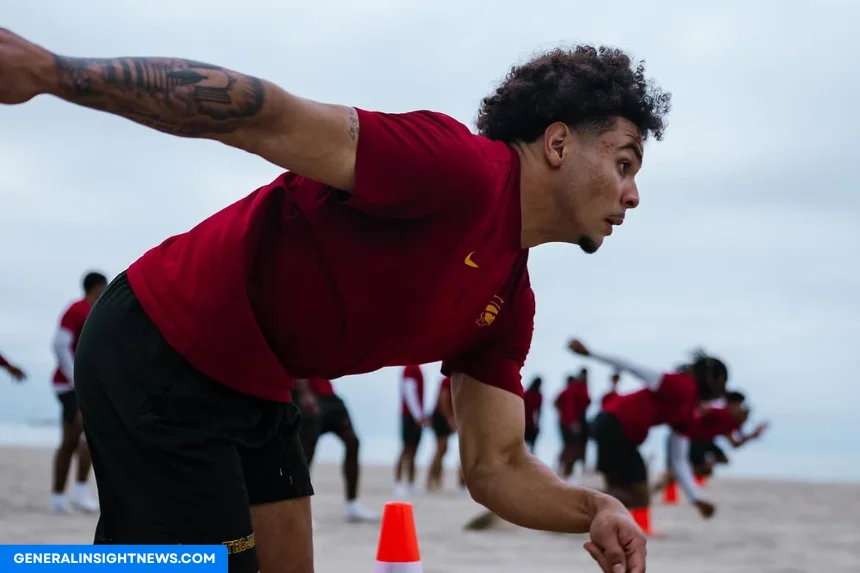
Kennedy Urlacher is a safety on USC’s 2026 spring roster. USC identifies him as a junior who transferred from Notre Dame in summer 2025. The university’s biography says he played in 13 games for the Trojans during the 2025 season, started three, and recorded 26 tackles, two interceptions, and one pass breakup.
This update matters because several older profiles still present Kennedy as a Notre Dame player. He began his college career there in 2024, but his official current team is USC as of August 3, 2026. Therefore, a current Tyna Robertson biography should use USC’s roster rather than recycling an outdated school reference.
Kennedy’s progress also changes the family context. During the heavily reported custody disputes, he was a minor whose privacy and living arrangements were central issues. Now, he is an adult athlete with a public football biography of his own.
What Happened in the Tyna Robertson and Urlacher Custody Dispute?
The custody history developed over years rather than through one final dramatic event. Reports describe disputes about visitation, missed parenting time, communication, travel, and where Kennedy should live. Therefore, any single headline captures only one stage of the family case.
Family-court proceedings also differ from criminal cases. Judges make parenting decisions according to a child’s interests and the evidence before them at that time. As a result, a temporary custody order should not be treated as a verdict about every allegation one parent made against another.
Why Did a Judge Order Parenting Classes?
In 2007, an Associated Press report hosted by the New England Patriots said a judge ordered both parents to attend a parenting class. The three-hour program followed disputes over visits and communication concerning their young son.
The report included competing accounts. Robertson criticized Urlacher’s parenting, while Urlacher’s attorney blamed Robertson for missed visits. However, the order applied to both parents, and the public report did not resolve every factual disagreement between them.
Therefore, the most defensible summary is that the judge sought to improve co-parenting amid conflict. It would be inaccurate to say the class itself proved one parent unfit. Moreover, parenting education is a case-management tool, not a criminal penalty.
Why Historical Custody Orders Need Date Context
Custody reports from 2006, 2007, and 2017 describe Kennedy as a baby, toddler, or school-age child. Today, however, he is an adult. Consequently, those orders belong to a historical timeline and do not define his present legal status.
This date context prevents another common problem in biography writing: using old present-tense news copy as though it remains current. A temporary order issued during an emergency can later change, and a child eventually reaches adulthood. Unless an accessible final order supports a broader conclusion, the article should describe only the dated ruling that was publicly reported.
The same care applies to claims about where Kennedy lived. An old report may accurately describe a living arrangement at that moment, but it cannot verify his residence years later. His current public relevance comes from his USC football career, not an outdated custody label.
Tyna Robertson’s Reported Marriages
Public reporting connects Robertson to William Goehrke and later to Ryan Karageorge. However, available details differ in quality. A sealed divorce file and the absence of an official personal biography mean that exact relationship dates should be handled cautiously.
Neither relationship should be merged with her earlier connection to Brian Urlacher. Robertson and Urlacher were not married. By contrast, reporting described Goehrke and Karageorge as husbands in separate periods.
Who Is William Goehrke?
Historic reporting and a court-photo caption identify William Goehrke as a former professional basketball player who was married to Robertson. The caption says she filed for divorce in 2011 and requested that the divorce file be sealed, which a judge granted.
Some biography pages provide a 2007 start date, label the relationship a civil union, or publish current employment details for Goehrke. Nevertheless, the sealed record and limited primary evidence make a detailed reconstruction risky. The useful verified point is that public reporting linked them as spouses and reported a 2011 divorce filing.
The sealed file also explains why responsible sources may offer fewer details than speculative pages. Privacy restrictions create an information gap; they do not validate whatever fills that gap online. Therefore, this article does not claim an exact wedding date, divorce outcome, or present relationship between them.
Who Was Ryan Karageorge?
Ryan Karageorge was Robertson’s later husband. A complaint Robertson filed after his death said they married on September 2, 2016, after dating for roughly eight months. Because that date appears through her pleading, it is best understood as her account in litigation rather than a separately reproduced marriage certificate.
Karageorge died from a gunshot wound at their Willow Springs, Illinois, home on December 29, 2016. Later reporting said the Cook County medical examiner ruled his death a suicide. The subject calls for restrained treatment because graphic detail adds no value to the biography.
His death immediately affected the family-court dispute over Kennedy. Nevertheless, later litigation shows that the parties disagreed sharply over how officials and other participants described Robertson afterward. Those accusations must remain attributed to the people who made them.
Ryan Karageorge’s Death and the Temporary Custody Order
After Karageorge died, Brian Urlacher sought emergency custody of Kennedy, who was 11 at the time. CBS Chicago reported that a judge granted temporary custody after an emergency motion.
The emergency filing used language about “suspicious circumstances” and raised concerns about the home environment. However, those were assertions made to obtain interim relief at an early stage. Later reporting that the death was ruled a suicide is essential context when reading the initial petition.
What Did the Emergency Order Decide?
The reported order temporarily placed Kennedy with Urlacher while the court considered the situation following Karageorge’s death. In practical terms, it changed who had immediate custody during that period. It did not permanently rewrite the child’s entire history or decide unrelated civil claims.
Emergency family orders often rely on a limited, fast-moving record because judges must address an immediate concern. Therefore, “temporary” is not a minor word; it identifies the nature of the relief. A biography should preserve it rather than simply saying Urlacher “won custody” without a date or qualification.
Robertson later sought to regain custody rights and disputed the way she had been portrayed. Those efforts generated more headlines, but the reporting reviewed does not provide a complete, privacy-safe final family-court file. Consequently, this article does not claim a final permanent arrangement.
What Did the Custody Order Not Establish About Tyna Robertson?
The temporary order did not establish that Robertson killed, caused, or criminally contributed to Karageorge’s death. It was a family-court response to an emergency request, not a criminal conviction. Moreover, later reporting said the medical examiner classified the death as suicide.
This distinction became central to Robertson’s later lawsuit. She alleged that Urlacher, lawyers, and others had portrayed her as responsible for the death and thereby damaged her reputation and parental rights. Those were her allegations, though; filing a complaint did not prove them.
Accordingly, an accurate article must avoid both extremes. It should not treat the emergency petition as proof against Robertson, and it should not treat her later complaint as proof that every defendant conspired against her. The verified story lies in what was filed, what was reported, and what courts actually decided.
Tyna Robertson’s $125 Million Lawsuit
In 2018, Robertson—using the name Tyna Karageorge—filed a wide-ranging civil case tied to the custody proceedings and the aftermath of her husband’s death. Reporting often calls it the “$125 million lawsuit” because that was the amount she sought. However, a demand for damages does not mean the plaintiff possessed, received, or was entitled to that amount.
The case named Brian Urlacher and several other people connected to the state proceedings. Robertson represented herself in federal court, a status known as proceeding pro se. Her pleadings asserted federal civil-rights theories along with state-law claims.
What Did Tyna Robertson’s Complaint Allege?
Robertson alleged that defendants worked together to portray her as an unfit mother and falsely connect her to Karageorge’s death. She claimed the conduct harmed her reputation, interfered with her relationship with her children, and affected the custody proceedings. Among other theories, her complaint invoked federal civil-rights statutes and state tort law.
These allegations explain why news headlines used terms such as defamation, conspiracy, and false light. Nevertheless, a complaint presents one side’s assertions at the start of a case. Courts do not treat every allegation as established merely because a clerk accepted the filing.
The large damages demand also attracted attention. Yet civil plaintiffs commonly request an amount they believe represents alleged injuries, punitive damages, and other relief. Therefore, $125 million should appear only as the amount requested, not as a settlement, judgment, income source, or financial valuation.
What Did the Federal Court Actually Dismiss?
The federal court’s November 2018 order dismissed the federal claims against the defendants who had been served. It concluded that the complaint did not state viable federal claims against them. The court then declined to continue exercising supplemental jurisdiction over the remaining state-law claims.
However, the treatment of Brian Urlacher and Thomas Raines was procedurally different. The order says they had not been served within the required time, so the court dismissed the claims against them without prejudice under Federal Rule of Civil Procedure 4(m). “Without prejudice” generally means the dismissal itself was not a merits judgment that permanently barred the same claim.
That nuance matters because simplified biographies say the federal court ruled for Urlacher or proved Robertson’s accusations false. The order does not support that broad statement. It closed the federal case, but claims against Urlacher were dismissed for lack of timely service rather than after a merits determination in his favor.
The court dismissed federal claims against served defendants with prejudice under the pleading rules. Meanwhile, it left state claims outside the federal case after relinquishing supplemental jurisdiction. Therefore, the most precise summary separates three outcomes: merits-related dismissal of federal claims against served defendants, jurisdictional treatment of state claims, and service-based dismissal of Urlacher and Raines.
Tyna Robertson and the Michael Flatley Litigation
Years before the later Urlacher custody litigation, Robertson became involved in a separate dispute with dancer and producer Michael Flatley. The public record includes a sexual-assault allegation, denials, Illinois civil filings, Flatley’s California lawsuit, an anti-SLAPP appeal involving Robertson’s attorney, a reported judgment, and a later civil contempt warrant.
Because those events span multiple courts and legal questions, short biographies often combine them incorrectly. The essential approach is to identify who alleged what, which action was dismissed, which party appealed, and what the appellate court actually held.
What Did Tyna Robertson and Michael Flatley Each Allege?
Robertson alleged that Flatley sexually assaulted her in a Las Vegas hotel in October 2002. Flatley denied the accusation and maintained that the encounter was consensual. The California Supreme Court’s later procedural history says Robertson filed an Illinois civil action for battery and intentional infliction of emotional distress in March 2003.
The same opinion notes that Robertson voluntarily dismissed that action and a subsequent action. Flatley, meanwhile, sued Robertson, her attorney D. Dean Mauro, and unnamed defendants in California. His claims included civil extortion, defamation, fraud, intentional infliction of emotional distress, and interference with prospective economic advantage.
These facts do not make a sexual-assault allegation simple to summarize. A civil filing is not a criminal conviction, and a voluntary dismissal does not by itself explain every reason behind a plaintiff’s decision. Therefore, this article reports the allegation, the denial, and the procedural history without offering an independent conclusion about the underlying encounter.
What Did Flatley v. Mauro Actually Decide?
The 2006 California Supreme Court opinion principally addressed whether attorney D. Dean Mauro could use California’s anti-SLAPP statute to strike Flatley’s claims arising from a demand letter and related telephone calls. The court held that Mauro’s communications constituted criminal extortion as a matter of law and therefore lacked anti-SLAPP protection.
Crucially, the opinion explicitly says Robertson was not a party to that appeal. Mauro was the appellant challenging the denial of his motion to strike. Consequently, it is misleading to write that the California Supreme Court directly ruled that Robertson committed criminal extortion in that appeal.
The opinion does say Mauro sent the letter on Robertson’s behalf and describes communications that involved demands, threatened publicity, and a request for a seven-figure payment. However, the appellate holding focused on Mauro’s communications and his attempt to invoke the anti-SLAPP statute. It did not function as a criminal trial of Robertson.
This distinction does not erase the larger litigation history; instead, it states it correctly. Flatley continued pursuing claims in the underlying case, while the Supreme Court resolved the narrower anti-SLAPP issue before it. Therefore, readers should not confuse an appellate procedural decision with the full disposition of every claim against every defendant.
What Was the Reported $11 Million Judgment?
In December 2007, The Irish Times reported an $11 million judgment for Flatley in litigation against Robertson. The report connected the award to defamation and intentional emotional distress and quoted Flatley characterizing the accusation as false and extortionate.
The judgment is separate from the Supreme Court’s 2006 anti-SLAPP ruling. The earlier appellate decision allowed the underlying claims to proceed past Mauro’s motion to strike; the later report concerned an award in the broader litigation. Combining those stages into a single ruling obscures both the chronology and the parties.
Moreover, a judgment amount does not reveal whether the creditor collected the full sum, what assets the debtor possessed, or what later enforcement proceedings occurred.
Why Was Tyna Robertson Arrested?
In December 2008, established Chicago reporting said authorities arrested Robertson on a civil contempt warrant issued after she missed a court date connected to enforcement of the $11 million judgment. Robertson reportedly said she had not received notice of the hearing.
The legal category matters. A civil contempt warrant can compel compliance with a court order, but the arrest should not be described as a new criminal conviction for sexual assault, extortion, or defamation. In addition, the short public reports reviewed do not establish a complete later disposition of the contempt matter. Sensational labels from old headlines add little and can mislead readers about what offense, if any, a criminal court adjudicated.
Tyna Robertson Timeline
The following timeline separates documented events from current unknowns:
| Date | Event |
|---|---|
| October 2002 | Robertson alleged that Michael Flatley sexually assaulted her in Las Vegas; Flatley denied the allegation and said the encounter was consensual. |
| March 2003 | Robertson filed an Illinois civil action based on the allegation. The California Supreme Court later noted that she voluntarily dismissed it and a subsequent action. |
| March 2003 | Flatley filed a California civil case against Robertson, attorney D. Dean Mauro, and unnamed defendants. |
| May 20, 2005 | Kennedy Urlacher was born to Robertson and Brian Urlacher. |
| July 27, 2006 | The California Supreme Court decided Flatley v. Mauro, holding that Mauro’s communications lacked anti-SLAPP protection because they constituted criminal extortion as a matter of law. Robertson was not a party to that appeal. |
| January 2007 | A judge ordered Robertson and Urlacher to attend a parenting class amid disputes over visits and co-parenting. |
| December 2007 | The Irish Times reported an $11 million judgment for Flatley in litigation against Robertson. |
| December 2008 | Chicago reporting said Robertson was arrested on a civil contempt warrant connected to the judgment. |
| 2011 | Historic reporting said Robertson filed for divorce from William Goehrke and obtained an order sealing the file. |
| September 2, 2016 | A later complaint said Robertson married Ryan Karageorge. |
| December 29, 2016 | Karageorge died from a gunshot wound. Later reporting said the medical examiner ruled the death a suicide. |
| January 2017 | A judge reportedly granted Urlacher temporary custody of Kennedy after an emergency motion. |
| 2018 | Robertson, as Tyna Karageorge, brought a federal civil case seeking $125 million and alleging misconduct tied to custody proceedings and her reputation. |
| November 27, 2018 | The federal court dismissed federal claims against served defendants, relinquished supplemental jurisdiction over state claims, and dismissed Urlacher and Raines without prejudice for failure of timely service. |
| 2024 | Kennedy began his college football career at Notre Dame. |
| Summer 2025 | Kennedy transferred to USC. |
| 2026 spring roster | USC lists Kennedy as a junior safety after a 2025 season in which he appeared in 13 games. |
Where Is Tyna Robertson Now?
Robertson’s current residence and day-to-day activities are not reliably documented. She appears to have maintained a relatively private profile after the most recent major litigation, but “private” should not be turned into a specific claim about where she lives, what work she performs, or whom she dates.
Some online profiles state that she resides in the United States or continues working as a real estate agent. Those statements may be plausible, yet no authoritative current source reviewed for this article establishes them. Therefore, they should not appear in a quick-facts table as confirmed present-tense details.
There is also no verified official social-media account that should be promoted as hers. Name matches on social networks do not prove identity. Moreover, private individuals deserve extra caution because a mistaken link can direct readers toward an unrelated person.
The most current public family update concerns Kennedy, not Robertson. As of August 3, 2026, USC lists him on its football roster. Beyond that, publicly available information remains limited, and the article should respect that boundary.
What Is Tyna Robertson’s Net Worth?
No authoritative financial source confirms Tyna Robertson’s net worth. She has not published audited accounts, a verified asset statement, a public company filing, or another dependable financial disclosure that would support a dollar estimate.
Online net-worth guesses can also misread her legal history. The $125 million in her 2018 complaint was a damages request, not money she received. Similarly, the reported $11 million judgment for Flatley was a legal award against her, not a verified statement of what she owned or what was ultimately collected.
Occupation labels do not solve the problem. Even if a 2007 report accurately described her as a real estate agent, that description provides no salary, commission history, property portfolio, liabilities, or current employment record. Therefore, calculating wealth from a decades-old job reference would be speculation.
The accurate answer is “not publicly verified.” Any page that supplies a precise figure should also produce reliable evidence explaining assets, debts, valuation date, and methodology. Without that evidence, the number offers false precision rather than useful information.
How to Read Claims About Tyna Robertson Accurately
First, check whether a source distinguishes Tyna Robertson from Tyna Karageorge. A profile that treats the names as separate people may split or duplicate the legal history. Conversely, a careful source will explain that later records use her married surname.
Second, look for verbs that attribute disputed claims. “Robertson alleged,” “Flatley denied,” “Urlacher’s petition asserted,” and “the court held” describe different kinds of statements. If a biography removes those verbs, it can transform an accusation into a supposed fact.
Third, examine the type of ruling. A temporary custody order is not a criminal verdict, an anti-SLAPP appeal is not a trial of every defendant, and a dismissal for failure of service is not a merits victory. Likewise, relinquishing federal supplemental jurisdiction over state claims does not necessarily determine those claims’ truth.
Fourth, treat personal-data tables skeptically when no source appears. Exact age, religion, ethnicity, body measurements, residence, and relationship status often spread through copy-and-paste biography networks. Repetition does not create verification.
Finally, separate litigation amounts from net worth. A plaintiff’s demand, a reported judgment, and money actually collected are different figures. Consequently, none can serve alone as an honest wealth estimate.
Frequently Asked Questions About Tyna Robertson
1. Who is Tyna Robertson?
Tyna Robertson is a private individual best known as Brian Urlacher’s former partner and Kennedy Urlacher’s mother. In addition, public reporting has covered her custody disputes and separate civil litigation involving Michael Flatley.
2. Is Tyna Robertson also Tyna Karageorge?
Yes. A federal court order identifies Tyna Karageorge as formerly known as Tyna Robertson. Therefore, later cases filed under Karageorge belong to the same person discussed in older Robertson reports.
3. Was Tyna Robertson married to Brian Urlacher?
No. Robertson and Urlacher were former partners and share a son, but they did not marry. Consequently, calling her Brian Urlacher’s ex-wife is inaccurate.
4. Does Tyna Robertson have a son with Brian Urlacher?
Yes. Their son is Kennedy Urlacher, born May 20, 2005. Official college-athletics material has identified Brian Urlacher and Tyna Karageorge as his parents.
5. Who is Kennedy Urlacher?
Kennedy Urlacher is a college football safety and the son of Tyna Robertson and Brian Urlacher. As of the 2026 spring roster, he plays for USC after transferring from Notre Dame in 2025.
6. What happened in the Tyna Robertson custody dispute?
Robertson and Urlacher had years of disagreements about parenting and visitation. Later, a judge reportedly granted Urlacher temporary custody after Ryan Karageorge’s 2016 death; however, that interim family order was not a criminal finding against Robertson.
7. Who was Ryan Karageorge?
Ryan Karageorge was Robertson’s husband. He died from a gunshot wound in December 2016, and later reporting said the medical examiner ruled his death a suicide.
8. What did Tyna Robertson’s federal lawsuit allege?
Robertson alleged that Urlacher and others harmed her reputation and parental rights by portraying her as unfit and connecting her to her husband’s death.
9. What did Flatley v. Mauro decide?
The California Supreme Court held that attorney D. Dean Mauro’s demand communications constituted criminal extortion as a matter of law and lacked anti-SLAPP protection.
10. What is Tyna Robertson’s net worth?
Tyna Robertson’s net worth is not publicly verified. Moreover, the amounts requested or awarded in lawsuits do not establish her assets, debts, earnings, or current wealth.
Conclusion: What the Verified Tyna Robertson Record Shows
Tyna Robertson is most accurately described as Brian Urlacher’s former partner, Kennedy Urlacher’s mother, and a private person whose name entered public records through several legal conflicts. Later court documents also identify her as Tyna Karageorge, which explains why searches under the two surnames lead to the same history.
The verified record supports several clear conclusions. Robertson and Urlacher did not marry; Kennedy now plays football at USC; a 2017 emergency order granted temporary custody to Urlacher; and Robertson later filed a federal case tied to the custody proceedings.
Similarly, Flatley v. Mauro should be summarized precisely. The California Supreme Court ruled on Mauro’s communications and anti-SLAPP motion, while explicitly noting that Robertson was not a party to the appeal. Later reporting documented an $11 million judgment and a related civil contempt warrant, but neither event supplies a reliable Tyna Robertson net-worth figure.
Ultimately, the unanswered details are part of the accurate story. No authoritative source reviewed here establishes Robertson’s exact age, birthplace, current residence, current occupation, present relationship status, or wealth. A trustworthy biography should say so instead of turning uncertainty into invented facts.
Read more at General Insight News