


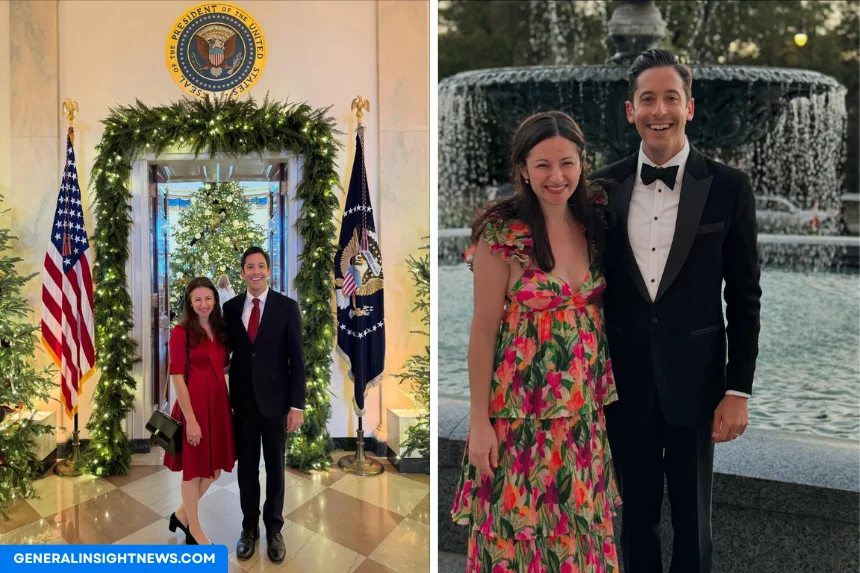
Alissa Mahler, now professionally identified as Dr. Alissa Rose Knowles, is an American psychology researcher and university educator whose work examines adolescent development and juvenile justice. She is also the wife of conservative political commentator Michael Knowles. However, unlike many online profiles suggest, Alissa has a substantial academic record that exists independently of her husband’s media career.
UC Irvine records show that she earned a Ph.D. in Psychological Science in 2019. Her doctoral work examined how young people’s expectations about the future relate to crime, risk-taking, impulse control, and decision-making. Moreover, university and government research databases document her contributions to studies of adolescent behavior and justice-system involvement.
Although her academic achievements are verifiable, many personal claims circulating online are not. Reliable sources do not confirm her exact birth date, current residence, height, weight, personal net worth, or a public social-media account. Therefore, this biography separates the documented record from repeated speculation.
Quick answer: Alissa Mahler is the earlier professional name of Dr. Alissa Rose Knowles, a psychological-science researcher and educator. She earned her doctorate from UC Irvine in 2019, later taught at Arizona State University, married Michael Knowles in 2018, and has three sons with him.
Alissa Mahler’s verified quick facts
| Category | Verified information |
|---|---|
| Earlier professional name | Alissa Mahler |
| Name used in her dissertation | Alissa Rose Knowles |
| Known for | Research in developmental psychology and juvenile justice |
| Highest degree | Ph.D. in Psychological Science |
| Doctoral university | University of California, Irvine |
| Doctorate completed | 2019 |
| Doctoral concentrations | Developmental psychology, quantitative methods, and psychology and law |
| Master’s degree | M.A. in Social Ecology, UC Irvine, 2016 |
| Bachelor’s degree | B.A. in psychology and history, University of Maryland, 2012 |
| Documented academic role | Assistant teaching professor at Arizona State University in the 2024–2025 faculty record |
| Spouse | Michael Knowles |
| Marriage year | 2018 |
| Children | Three sons |
| Main research subjects | Adolescence, future expectations, juvenile offending, impulse control, and psychosocial development |
Who is Alissa Mahler?
Alissa Mahler is a researcher whose academic work focuses on how adolescents think about their futures and how those beliefs relate to risky or unlawful behavior. She published several early studies under the name Alissa Mahler. After marrying Michael Knowles, she published and taught under the name Alissa Knowles.
That name change has contributed to confusion. Some profiles treat Alissa Mahler and Alissa Knowles as different people. Others correctly connect the names but provide no evidence explaining the connection.
Her UC Irvine doctoral dissertation resolves the issue. The document identifies its author as Alissa Rose Knowles, yet its curriculum vitae includes earlier presentations and research published under Mahler. Moreover, the acknowledgments thank her husband, Michael, for supporting her throughout her doctoral work.
Consequently, the academic record establishes that the researcher known earlier as Alissa Mahler later used Alissa Rose Knowles professionally. This is more reliable than matching photographs, recycling celebrity profiles, or assuming that two people with similar credentials must be the same person.
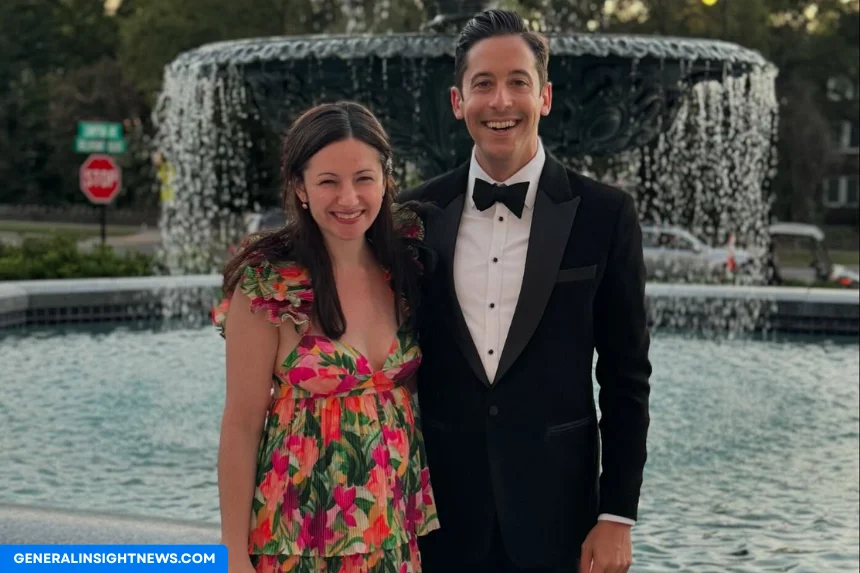
Is Alissa Mahler the same person as Alissa Knowles?
Yes. The research record strongly establishes that Alissa Mahler and Dr. Alissa Rose Knowles are the same academic.
A 2017 paper on aspirations, expectations, impulse control, and juvenile delinquency lists Alissa Mahler as an author. Similarly, a U.S. Department of Justice database identifies Alissa Mahler as a coauthor of research concerning adolescent impulse control and environmental influences.
After her 2018 marriage, later publications list Alissa Knowles. Her dissertation’s curriculum vitae also combines projects credited to Mahler and Knowles in one academic history. Therefore, the surname difference reflects a change in professional name rather than a separate researcher.
This distinction matters for readers evaluating her career. Searching only “Alissa Mahler” can hide later publications, teaching records, and institutional profiles listed under Knowles. Conversely, searching only “Alissa Knowles” can miss the earlier research that established her scholarly focus.
What is Alissa Mahler’s full name?
Her 2019 dissertation identifies her as Alissa Rose Knowles. Earlier academic publications identify her as Alissa Mahler.
Some biography websites describe “Alissa Rose Knowles” as her official married name. That description is broadly consistent with her academic record. Nevertheless, the dissertation—not a celebrity profile—is the strongest evidence for the full name she used professionally after marriage.
Reliable public sources do not establish whether Rose is a birth middle name, a later addition, or part of another naming history. Therefore, the accurate statement is limited: her doctoral dissertation and subsequent professional records use Alissa Rose Knowles.
Alissa Mahler’s early life
Publicly available evidence about Alissa Mahler’s early life remains limited. However, Michael Knowles has supplied some first-person context about how they met.
In a 2023 episode of The Lila Rose Show, Michael described Alissa as his high-school sweetheart. He recalled meeting her during their school years, possibly in a fifth-grade orchestra or sixth-grade homeroom. He also connected her childhood to Bedford Village, New York, while he grew up in nearby Bedford Hills.
That account conflicts with profiles claiming Alissa was born and raised in Nashville, Tennessee. No authoritative source reviewed for this article confirms Nashville as her birthplace. Moreover, Michael’s account places her in New York during childhood.
Still, attending school in New York does not conclusively establish where she was born. A person can move during childhood. Therefore, this article does not assign Alissa a birthplace without a birth record, official biography, or direct statement.
Her parents and siblings are mentioned in her dissertation acknowledgments. Nevertheless, those names are not necessary to answer the main search intent, and her relatives have not sought the same public attention. This biography therefore focuses on Alissa’s education, research, and documented family life rather than expanding a private family tree.
Did Alissa Mahler attend Yale University?
Alissa Mahler’s own academic curriculum vitae does not list Yale University. Instead, it documents undergraduate study at the University of Maryland and graduate study at UC Irvine.
The Yale claim probably developed because Michael Knowles attended Yale. Some websites then assumed that Alissa also attended Yale or that the couple met there. However, Michael’s first-person account says they knew each other years before college.
Reliable evidence therefore supports the following educational path:
- University of Maryland, College Park
- University of California, Irvine
- Academic teaching work later documented at Arizona State University
Alissa may have visited Yale or participated in activities that are not listed publicly. Nevertheless, the available record does not support presenting her as a Yale graduate.
Alissa Mahler’s education
Alissa’s education can be verified in unusual detail because her dissertation includes an academic curriculum vitae. That record documents three earned degrees and several honors.
Bachelor’s degree at the University of Maryland
Alissa earned a Bachelor of Arts from the University of Maryland, College Park, in 2012. She completed a double major in psychology and history and graduated cum laude.
The psychology major fits her later work in developmental science. Meanwhile, a history major can strengthen skills such as evaluating sources, constructing evidence-based arguments, and examining institutions over time.
Her dissertation CV also records membership in Phi Beta Kappa in 2012. Phi Beta Kappa recognizes academic achievement in the liberal arts and sciences. Additionally, the record lists multiple years on the University of Maryland’s College of Behavioral and Social Sciences Dean’s List.
These details are more dependable than claims about childhood hobbies or favorite school subjects. They appear in an academic document submitted as part of her doctoral degree.
Research training after college
From 2012 to 2014, Alissa received an Intramural Research Training Award associated with the National Institutes of Health. Her CV places this experience before she began graduate study at UC Irvine.
That training period helps explain her transition from undergraduate psychology to advanced quantitative and developmental research. However, it should not be exaggerated into an undefined permanent position at the National Institutes of Health.
The record establishes research training during a specific period. It does not establish that she still works for a federal research institute.
Master’s degree at UC Irvine
Alissa entered UC Irvine’s graduate program in 2014. She completed a Master of Arts in Social Ecology in 2016.
Social ecology examines the relationship between individuals and their social, institutional, and physical environments. Therefore, the field fits her work on how homes, schools, neighborhoods, developmental traits, and justice-system experiences can influence adolescent behavior.
During graduate school, she worked with researchers studying psychology and law. She also contributed to projects involving justice-involved adolescents and long-term developmental outcomes.
Ph.D. in Psychological Science
Alissa completed her Ph.D. in Psychological Science at UC Irvine in 2019. Her concentrations were developmental psychology, quantitative methods, and psychology and law.
Developmental psychology examines how thinking, behavior, emotion, and social relationships change over time. Quantitative methods provide tools for analyzing those patterns. Psychology and law, meanwhile, applies psychological knowledge to legal institutions, procedures, and outcomes.
Together, these concentrations created a clear academic specialty. Alissa studied adolescent decision-making with methods capable of following changes across multiple years.
What was Alissa Mahler’s doctoral dissertation about?
Alissa’s dissertation was titled A Longitudinal Examination of the Relation Between Future Expectations and Crime. It examined how adolescents’ beliefs about their futures related to crime and other risky behavior.
The word “longitudinal” is important. Instead of examining participants at only one moment, longitudinal studies gather information repeatedly. Researchers can then observe whether changes in expectations, maturity, circumstances, or behavior occur together over time.
Her dissertation used information from two major research projects involving adolescent males who had contact with the justice system:
- The Crossroads Study included young people who experienced a first arrest for a relatively low-level offense.
- The Pathways to Desistance study followed adolescents arrested for more serious offenses.
The research did not argue that one thought or personality trait inevitably causes crime. Instead, it examined relationships among future expectations, impulse control, perceived rewards, social costs, estimated life expectancy, and self-reported offending.
Future expectations versus future orientation
One part of the dissertation distinguished future expectations from future orientation.
Future expectations concern whether someone believes a desired outcome will actually happen. For example, a teenager may consider graduating important but believe graduation is unlikely.
Future orientation, by contrast, concerns how much a person considers the long-term consequences of current decisions. A young person may feel optimistic about the future while still making decisions without carefully considering delayed effects.
Alissa’s research treated these concepts as related but distinct. That distinction helps explain why optimism alone may not prevent risky behavior. A person can believe that life will improve while lacking the decision-making habits needed to connect present behavior with future goals.
Social rewards and offending
Another part of the dissertation examined possible mechanisms connecting low expectations with offending. These mechanisms included impulse control and the perceived personal or social rewards and costs of crime.
The analysis identified perceived social rewards as an important part of the relationship in the studied sample. In simpler terms, adolescents with lower expectations could view offending as offering more social benefits, such as status or approval.
However, this finding should not become a universal claim about every justice-involved young person. The study examined defined samples, specific measures, and statistical relationships. Responsible reporting should preserve those boundaries.
Estimated life expectancy
The third section studied adolescents’ estimated life expectancy—the age to which they expected to live—and its relationship with offending.
Believing that life may be short can influence the value a person assigns to distant consequences. If the future feels uncertain or unreachable, an immediate reward may seem more meaningful.
Nevertheless, estimated life expectancy is not a literal prediction of death. It is a psychological measure of how participants imagine their future. Alissa’s research used it to examine changes in expectations and behavior across development.
Alissa Mahler’s juvenile-justice research
Alissa’s academic record includes several research themes rather than one isolated paper. Her work appears in developmental psychology, criminology, youth studies, and psychology-and-law scholarship.
Aspirations, expectations, and delinquency
One early study examined aspirations and expectations among adolescent first-time offenders. Aspirations refer to the importance someone assigns to a goal. Expectations refer to the perceived likelihood of achieving it.
A student might strongly value college attendance but believe admission is unlikely. Therefore, the gap between aspiration and expectation can affect motivation, strain, and behavior.
The research also examined impulse control. Its findings suggested that aspirations may influence behavior differently depending on whether adolescents can connect present choices with future goals.
This does not mean that low impulse control defines a child’s character. Instead, impulse control develops over time and interacts with families, schools, neighborhoods, opportunities, and other circumstances.
Home, school, and neighborhood influences
A separate study listed by the U.S. Department of Justice’s Office of Justice Programs examined the relationship between impulse control and home, school, and neighborhood environments.
The study used a racially diverse sample of more than 1,200 male adolescents following a first arrest. It tested how environmental context and individual differences worked together.
This framework avoids a simplistic choice between personal responsibility and social environment. Instead, it asks whether individual characteristics can change how strongly environments affect behavior.
For example, supportive institutions may provide greater benefits to some adolescents, while adverse environments can create different risks depending on developmental traits. Such questions can inform prevention and rehabilitation programs.
Expectations after a first arrest
Another article, indexed by the National Library of Medicine, examined expectations for future success among adolescent first-time offenders.
The study considered whether optimistic expectations predicted changes in offending and academic performance during the years following an arrest. Research of this kind matters because a first arrest does not determine a young person’s future.
If expectations can change, interventions might help young people translate ambitions into realistic steps. However, effective support also requires attention to structural barriers, school opportunities, family circumstances, and community resources.
Psychology and juvenile-justice reform
Alissa also coauthored work on how developmental science can influence juvenile-justice reform. Developmental research has helped courts and policymakers recognize that adolescents differ from adults in decision-making, susceptibility to peers, self-regulation, and capacity for change.
Nevertheless, developmental science does not support treating every adolescent identically. Age is important, but personal history, context, offense circumstances, maturity, and available support also matter.
Alissa’s contribution sits within a broader effort to apply empirical research to legal policy. The goal is not simply to excuse harmful behavior. Instead, developmental evidence can help legal systems choose responses that improve public safety while recognizing the potential for rehabilitation.
Was Alissa Mahler a clinical psychologist?
The available record identifies Alissa as a psychological-science researcher and educator. It does not establish that she practices as a licensed clinical psychologist.
A Ph.D. in Psychological Science does not automatically indicate clinical licensure. Psychology contains many specialties, including developmental, social, cognitive, quantitative, forensic, experimental, counseling, and clinical psychology.
Alissa’s documented work concerns developmental psychology, quantitative methods, and psychology and law. Therefore, describing her as a developmental-psychology researcher is appropriate. Calling her a therapist, clinical psychologist, counselor, or mental-health provider would require separate licensure evidence.
This distinction is important because biography pages often use “psychologist” as if every psychology doctorate involves clinical treatment. Academic research and clinical practice overlap in some careers, but they are not interchangeable.
Alissa Mahler’s teaching career
After earning her doctorate, Alissa’s professional record moved from graduate research toward university teaching.
Arizona State University’s 2024–2025 instructional faculty list identifies Alissa Knowles as an assistant teaching professor in the School of Interdisciplinary Forensics. The same record lists her 2019 doctorate from UC Irvine.
Interdisciplinary forensics combines knowledge from psychology, law, criminal justice, biology, investigation, and related fields. Alissa’s training in adolescent development and psychology and law fits that academic setting.
Public course materials have also associated her with correctional psychology and forensic-psychology education. However, third-party course repositories should not define her current teaching schedule. Course assignments and faculty titles can change.
Therefore, the most precise wording is that ASU officially listed her as an assistant teaching professor for the 2024–2025 academic period. Without a newer accessible appointment record, the article should not assume that every detail remains unchanged in 2026.
Is Alissa Mahler a professor?
Yes, an official ASU faculty list identifies Alissa Knowles as an assistant teaching professor. However, the exact title matters.
An assistant teaching professor usually focuses heavily on instruction, curriculum, student support, and teaching-related service. Depending on the university, it may differ from a tenure-track assistant professor position centered on both research and teaching.
Consequently, “university professor” is accurate in a general biography. Still, “assistant teaching professor” is the more precise documented title for the period covered by ASU’s record.
How many research papers has Alissa Mahler published?
ResearchGate has associated Alissa Knowles with approximately 12 publications. However, publication totals vary depending on the database and counting method.
One database may count journal articles only. Another may include book chapters, law-review articles, conference papers, preprints, or publications later updated under a married name. Duplicate author profiles can also split a scholar’s work.
Therefore, “about a dozen documented research publications” is safer than presenting a permanent exact total. Her dissertation CV, academic databases, and publisher pages clearly demonstrate multiple scholarly contributions.
More importantly, publication quality and contribution matter more than a raw count. Her record includes work in established journals and research programs involving adolescent development and juvenile justice.
How did Alissa Mahler meet Michael Knowles?
Michael Knowles says that he and Alissa first knew each other during their school years in New York. In his Lila Rose interview, he recalled a possible first meeting in a fifth-grade orchestra. Alissa’s recollection, according to Michael, placed their meeting in sixth-grade homeroom.
Michael also indicated that the relationship developed during adolescence. He described Alissa as his high-school sweetheart and suggested that he recognized the importance of the relationship when they were young.
This first-person account corrects a common online mistake. The couple did not first meet at Yale, according to Michael. Indeed, Alissa’s documented academic history does not list Yale.
Some profiles state that they began dating in 2006. That timing may fit the high-school account, but Michael’s interview is more useful than an unexplained exact date. It establishes a long relationship beginning well before their marriage.
When did Alissa Mahler marry Michael Knowles?
Alissa Mahler and Michael Knowles married in June 2018. Established profiles commonly give June 3 as the wedding date, although a first-party marriage record was not located during this research.
The couple had known each other for many years before marrying. Therefore, their wedding represented the continuation of a relationship dating back to their school years.
By 2019, Alissa’s dissertation appeared under the name Alissa Rose Knowles. In its acknowledgments, she thanked her husband, Michael, for his critiques, encouragement, and emotional support throughout her academic work.
That acknowledgment provides a valuable perspective on their marriage. It shows Michael’s connection to Alissa’s doctoral journey without reducing her achievements to her husband’s involvement. Alissa conducted the research, completed the analyses, wrote the dissertation, and earned the degree.

Who is Michael Knowles?
Michael Knowles is an American conservative political commentator, podcast host, author, and media personality. He became widely known through The Michael Knowles Show and his work with The Daily Wire.
He graduated from Yale University and initially pursued acting before moving into political media. His public career includes books, online video, speaking engagements, podcasts, and political commentary.
Alissa’s work differs significantly from Michael’s. His career centers on media, political arguments, and public communication. Her documented work centers on psychology, quantitative research, juvenile justice, and university teaching.
Therefore, calling Alissa a political commentator or television personality because she married Michael is inaccurate. Likewise, there is insufficient evidence to assign Michael’s political opinions to her.
A spouse’s public views do not automatically establish the other spouse’s beliefs. Unless Alissa speaks publicly on a specific issue, her positions should not be inferred from Michael’s work.

Alissa Mahler and Michael Knowles’s relationship timeline
| Period | Documented development |
|---|---|
| School years | Michael says they met in elementary or middle school in New York |
| High school | Their relationship developed during adolescence |
| 2008–2012 | Alissa studied psychology and history at the University of Maryland |
| 2012–2014 | She completed research training before graduate school |
| 2014 | Alissa began graduate study at UC Irvine |
| 2016 | She earned an M.A. in Social Ecology |
| 2017 | The couple became engaged, according to widely cited biographical accounts |
| June 2018 | Alissa and Michael married |
| 2019 | Alissa completed her doctorate under the name Alissa Rose Knowles |
| 2021 | Michael publicly acknowledged the arrival of their first son |
| 2022 | The couple welcomed another son |
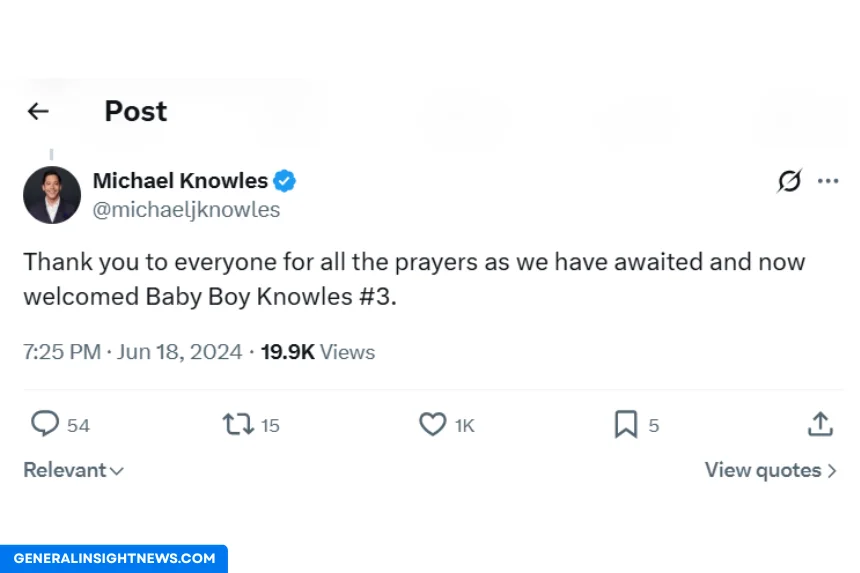
| June 2024 | Michael announced the arrival of “Baby Boy Knowles #3” |
The timeline avoids publishing the children’s names or private identifying information. Their number and general birth sequence answer legitimate public questions without unnecessarily profiling minors.
How many children do Alissa Mahler and Michael Knowles have?
Alissa and Michael Knowles have three sons. Michael confirmed the arrival of their third son in an official June 2024 announcement.
Older articles that list one or two children are outdated. They may have been accurate when published, but the family later grew.
Other profiles publish supposed names, birth measurements, photographs, or detailed timelines for the children. However, minors deserve additional privacy, particularly when they are known only because of a parent’s public career.
Therefore, this article confirms the number of children without building individual profiles around them.
What role does faith play in their marriage?
Michael Knowles speaks publicly about Catholicism and has discussed faith in relation to marriage, family, and his own conversion. His 2023 interview with Lila Rose focused partly on those subjects.
Alissa’s dissertation also ends its acknowledgments by expressing gratitude to God. That statement provides first-party evidence that faith mattered to her during her doctoral journey.
Nevertheless, her exact religious practices, parish activities, and personal theological views should not be expanded beyond what she has publicly documented. It is accurate to say that faith forms part of the couple’s public family story. It would be inaccurate to manufacture detailed beliefs for Alissa based solely on Michael’s commentary.
How old is Alissa Mahler?
Alissa Mahler’s exact age is not confirmed by a reliable public birth record or first-party statement.
Her university timeline indicates that she began undergraduate study in 2008 and graduated in 2012. That information may suggest an approximate age range. However, students begin college at different ages, take alternative educational paths, or accelerate their schooling.
Several websites assign her a 1990 birth year. One search result even gives August 17, 1990. Nevertheless, those pages do not provide an authoritative record supporting the date.
Therefore, an accurate biography should not publish a precise age. The education timeline is verified; the birth date is not.
Where was Alissa Mahler born?
No authoritative source reviewed for this article establishes Alissa’s birthplace.
Several competitors claim Nashville, Tennessee. However, Michael Knowles’s account connects her school years to Bedford Village, New York. These facts are not necessarily impossible to reconcile, but the Nashville claim lacks strong sourcing.
Accordingly, the available evidence does not establish where she was born. Describing her as American is reasonable based on her education and professional history, but a specific birthplace requires better documentation.
Where does Alissa Mahler live?
Alissa’s present residence has not been established through a recent authoritative public source.
Older profiles connect the couple to Los Angeles. Her later teaching record connects her professionally with Arizona State University. However, employment does not always prove a permanent residence, especially when universities offer online or hybrid teaching.
Publishing an address, neighborhood, or property detail would also raise unnecessary privacy concerns. The search intent can be satisfied without disclosing sensitive location information.
Therefore, the accurate answer is that her current residence has not been independently verified.
Is Alissa Mahler active on social media?
No verified public social-media account for Alissa was established during this research.
Third-party people-search platforms and unverified profiles may associate accounts with her name. However, a shared name does not prove identity. “Alissa Knowles” is not unique, and some results may refer to unrelated people.
Michael has shared limited family updates through his official accounts. Still, appearing in a spouse’s post does not mean Alissa operates a separate public profile.
Unless an account is linked from an official academic page, acknowledged by Alissa or Michael, or otherwise authenticated, publishers should not label it as hers.
What is Alissa Mahler’s net worth?
No authoritative financial source confirms Alissa Mahler’s individual net worth.
Competitor estimates range from approximately $300,000 to $500,000. Other pages combine her finances with Michael’s and claim that the household is worth several million dollars. Yet these estimates lack tax records, contractual disclosures, audited statements, verified asset records, or first-person financial reporting.
An academic title does not reveal a person’s savings, investments, debts, property ownership, or household financial arrangements. Similarly, Michael’s media visibility does not establish Alissa’s personal wealth.
Therefore, the evidence does not support a reliable net-worth figure. The correct answer is that Alissa Mahler’s net worth has not been publicly verified.
Why do online biographies get Alissa Mahler wrong?
Several factors contribute to inaccurate profiles.
First, her professional surname changed. Earlier papers appear under Mahler, while later work appears under Knowles. Without examining the dissertation and publication record, writers may miss part of her career.
Second, her husband has a much larger public profile. Websites therefore build articles around Michael, then fill missing details about Alissa with assumptions.
Third, celebrity-biography templates encourage publishers to include age, height, weight, birthplace, hobbies, social accounts, residence, and net worth. When verified information is unavailable, some pages insert estimates instead of leaving a field out.
Fourth, outdated articles remain visible. A profile published before June 2024 may state that the couple has one or two children even though Michael has since confirmed three.
Finally, pages copy one another. Once one site claims that Alissa attended Yale or was born in Nashville, the statement can spread without anyone locating an original source.
A better biography begins with institutional records, first-person interviews, academic publications, and official announcements. Only then should secondary profiles be used to identify remaining reader questions.
Frequently asked questions about Alissa Mahler
1. Who is Alissa Mahler?
Alissa Mahler is a developmental-psychology researcher and university educator now professionally known as Dr. Alissa Rose Knowles. She is also Michael Knowles’s wife.
2. Is Alissa Mahler a psychologist?
She holds a Ph.D. in Psychological Science and specializes in developmental psychology, quantitative methods, and psychology and law. However, reliable records do not establish that she works as a licensed clinical psychologist or therapist.
3. Where did Alissa Mahler attend college?
She earned a psychology and history bachelor’s degree from the University of Maryland. Later, she completed an M.A. in Social Ecology and a Ph.D. in Psychological Science at UC Irvine.
4. Did Alissa Mahler attend Yale?
Her official academic CV does not list Yale. Moreover, Michael Knowles says they met during their school years, not at Yale.
5. What does Alissa Mahler research?
Her work covers adolescent development, juvenile offending, future expectations, impulse control, psychosocial maturity, and environmental influences on behavior. In addition, she has contributed to research connecting developmental science with juvenile-justice policy.
6. Where does Alissa Mahler work?
Arizona State University’s 2024–2025 faculty list identifies Alissa Knowles as an assistant teaching professor in the School of Interdisciplinary Forensics. A newer accessible record would be needed to confirm whether that exact position remains unchanged.
7. When did Alissa Mahler marry Michael Knowles?
Alissa and Michael married in June 2018. They had known each other since their school years and dated long before the wedding.
8. How many children do Alissa Mahler and Michael Knowles have?
They have three sons. Michael announced the arrival of their third son in June 2024.
9. How old is Alissa Mahler?
Her exact birth date and age have not been verified by an authoritative source. Therefore, the widely repeated 1990 birth year should be treated as unconfirmed.
10. What is Alissa Mahler’s net worth?
No authoritative financial source confirms her personal net worth. Online figures between $300,000 and $500,000 are estimates rather than verified financial facts.
Conclusion
Alissa Mahler is much more accurately described as a psychologist, researcher, and educator than as a conventional celebrity spouse. Under the married name Alissa Rose Knowles, she earned a Ph.D. in Psychological Science from UC Irvine and developed a documented body of work concerning adolescent development, future expectations, delinquency, and juvenile justice.
She married Michael Knowles in 2018 after knowing him since their school years. The couple now has three sons. Nevertheless, Alissa has maintained far less public visibility than her husband.
Reliable records do not confirm her exact age, birthplace, residence, measurements, social-media account, or net worth. Leaving those claims unlisted produces a more complete and trustworthy Alissa Mahler biography than filling the gaps with speculation.
Read more at General Insight News